
Tracing the Evolution of Palestinian Insurance


Thaer Hurani
Tracing the Evolution of Palestinian Insurance
Books2bits
Thaer Hurani
Cite este libro:
Hurani, T. (2026). Tracing the Evolution of Palestinian Insurance. Books2bits. https://doi.org//10.51438/B2Bhurani2026
Colección:
Economías y Sociedades, 4


Acknowledgements
At this moment, words are crowded together to express my thanks and gratitude to my supervisor, Dr. Leonardo, for his support and assistance during my doctoral period. Thank you very much, Dr. Leonardo and I’m very proud to have studied under your supervision. Thank you very much for all the academic skills and information that you have provided me with. I am proud of my friendship with you, and I hope it will continue forever.
I also thank my father for all the support, encouragement and help he gave me and I say to him: Be proud of your son who was a reward for your hard work and the happiness of your life and the greatest thanks to the spirit of the dear mother who sacrificed so that we could be the best and now, after more than ten years since your death, I say to you that I have completed my doctorate degree to fulfill your wish that you wanted me to accomplish and therefore I dedicate this achievement to my parents.
I also thank my great family for their support, trust and belief that I will achieve this accomplishment. I am grateful to all of them. Thank you all, the most beautiful family.
I must thank the wonderful Dr. Ibrahim Awad, Dean of the Faculty of Commerce and Economics at Al-Quds University, for his valuable advice in the field of scientific research and statistics, and for his support and constructive follow-up during my journey in the doctoral program and before it. Dr. Ibrahim, thank you for everything you have provided to me and you are one of the contributors to this achievement.
I also thank the wonderful Dr. Eyad Khalifa for all the support, assistance and intellectual enrichment he provided me with. Therefore, I say to you, thank you very much, Dr. Eyad, for everything you provided me with in my academic journey, and I am happy with my friendship with you.
Finally, I would like to thank all my friends, colleagues, Palestinian institutions, and personalities I met, as well as everyone who contributed to the completion of this study, which will contribute to the development and building of the Palestinian insurance sector.
Dr. Thaer I. M. Hurani
Introduction
The insurance sector is considered one of the most important non-banking sectors in the economies of countries because of its importance in achieving reassurance for members of society and reducing the risks to which they are exposed in their commercial and economic activities. The roots of the idea of insurance go back to Chinese and Babylonian merchants in the third and second millennium BC, respectively. Where Chinese merchants were traveling along the slopes of rivers and were redistributing their goods across many ships to reduce the loss resulting from any of the ships being exposed to the risk of sinking or theft. And then the Babylonians developed a system recorded in the famous Hammurabi Law, c. 1750 BC, and this system indicates that if the merchant gets a loan to finance its shipment, it pays an additional amount to the lender in exchange for guaranteeing the lender by canceling the loan in the event of the charge or losing the shipment in the sea.
The Greeks and Romans also contributed to building health insurance assets and life insurance C. 600 BC when they created unions who are interested in the families of the deceased members and also pay the expenses of the funeral of the members. The Jewish Talmud also addresses several aspects of goods insurance. Before the establishment of insurance in the late seventeenth century, there were «friendly societies» in England, where people were donating money to a general amount that could be used in emergency situations.
Given the historical narration, we note that the idea of insurance evolved through time and most civilizations around the world added to it a new addition that contributed to the development of the idea of insurance through the multiplicity of risks that a person faces since his inception and enhanced the London fire in 1666, which devoured 13,000 homes of the necessity of establishing a fire insurance to protect property. They resulted in this effort, the first company against the fire (the insurance against homes) in 1681 by the economist Nicholas Barron and the eleven of his partners, and 5,000 homes were secured in that period.
In the wake of this first successful project, many similar companies were established in the following contracts. Each company has employed its extinguishing department to prevent and reduce the damage caused by fires on the property secured by it. They also started issuing «ire insurance signs» to their customers. One of these prominent companies was the Hand In Hand Fire & Life Insurance Society, which was founded in 1696 in Tom's Coffee House at St. Martin's Lane in London. It was organized as a joint community, operated its own extinguishing squad for 135 years and played an important role in forming fire control and prevention. Sun Fire Office is the oldest property insurance company that exists so far, dating back to 1710.
As for the historical narrative of the insurance sector in the Arab world, Insurance business began in the Arab world in the late nineteenth century. European insurance company agencies were established in the capitals of Arab countries, where European-owned companies operated in companies operating in the region. The year 1900 saw the establishment of the first Arab national insurance company (the Egyptian National Insurance Company), but between then and 1945 a few other similar companies were established. However, after the Arab countries gained their independence, especially in the 1960s and 1970s, many local companies were established.
Even after the establishment of national companies, foreign companies continued to dominate the Arab insurance market for several years. This situation has been reversed in the past two decades, through the domestication and sometimes nationalization of many markets. Although the number of Arab companies nearly tripled between 1960/61 and 1982, they represented only 1.6% of the total number of companies operating worldwide and less than 10% of companies registered in developing countries. The ratio of foreign companies to local companies operating in the Arab region is still much higher than in other developing regions of the world. But the situation varies between countries and on the contrary, there has been a large influx of foreign insurance companies into the UAE and Saudi Arabia, due to their great development potential and lack of insurance regulation.
Whereas in 1979, there were 71 insurance companies operating in the UAE. The company shared a total premium income of just USD 133 million, of which more than 40% was underwritten by the largest company, and in Saudi Arabia there was a much larger volume of business available. However, intense competition in both countries has reduced premium prices to such an uneconomic level that some companies are now pulling out. Before 1970, premium income in all Arab insurance markets was very small indeed. Despite the rapid growth that the insurance business has witnessed since then, Arab insurance markets are still in their infancy.
The creation of insurance companies through the emergency risks facing individuals and societies led to the emergence of the importance of the individual, society, to companies and institutions by providing financial support and reducing the uncertainty that individuals and companies face in each step of their life cycle. It provides an ideal mechanism for relieving risks against events that can cause financial hardship for individuals and companies, which contributes to a sense of security among individuals and investors in seeking to increase their business and investments, which reflects positively on the reciprocal and social stability of various countries and also generates the insurance sector in the insurance premiums collected from millions of holders of holders Insurance documents. Consequently, they are invested in building long -term infrastructure assets (such as roads, ports, power stations, dams, etc.) which are important to building the state. In addition to that insurance provides support for families in the stories of medical risks and any risk facing family members, which contributes to internal stability for family members that the welfare of the family is important to all and the health of family members is the largest source of concern for most people. From the elderly parents to newborns, medicines and hospital treatment play an important role in ensuring the welfare of families. The high costs of medical treatment and high medicine prices are sufficient to deplete the savings of these families; anyone can make a victim of serious diseases unexpectedly. The high medical expenses constitute great concern. Medical insurance is a policy that protects individuals financially against various types of health risks. With a health insurance policy, the insured gets financial support in the event of medical emergency. One of the most important principles of insurance is the spread of risks; the insurance is easy to transfer the risk of loss from the insured to the insured. The basic principle of insurance is the distribution of risks between a large number of people. A large number of populations get insurance documents and pay insurance premiums for the insurance company. Whenever a loss occurs, it is compensated by the collection of money collected from millions of insurance documents holders (Insurance importance, 2023).
In fact, it aims to provide guarantees and security to people against risks that cannot be predicted and the degree of their seriousness and the resulting damage cannot be known. Insurance is based on the idea of cooperation, whereby people who anticipate the occurrence of these risks gather and cooperate to pay compensation to those who suffer harm from the common balance consisting of everyone’s contribution. The insurance sector is concerned with achieving safety, especially for the individual, as it searches for all means and methods that would reduce the resulting loss or risks that befall every physical or moral person.
Therefore, insurance has an important role in developing the economies of countries, and no one ignores its importance in advancing the economic and social development of the country. This is done in several aspects. First, protection from financial loss. This is done by protecting against many major risks facing companies and business institutions, such as the risks that come with running a business, starting from data breaches and natural disasters to injuries and supply chain disruption. With a policy in place, businesses have a buffer against the financial consequences of events that could close their doors, including those that could cause millions of dollars in losses. On the consumer side, insurance acts as a shield against unexpected personal expenses, mitigating costs and property damage.
As a result, consumers can preserve their purchasing power and stimulate the economy through purchases in difficult and prosperous times. Secondly, protecting the economy during crises, insurance companies provide a safety net and mitigate losses in periods of economic recession and periods of inflation. When consumers lose their purchasing power, insurance prevents widespread social inequality by preventing further asset losses (D'Aprile, 2023). Insurance contributes to providing an appropriate climate of stability, which contributes to the availability of foreign investment. Involving international investors in the modernization of the region's economies is crucial, helping to attract sufficient financial resources and mobilize necessary knowledge and technology transfers. However, foreign investors face uncertainty, and political risk is seen as the biggest barrier to inward investment in emerging economies. This is evident in resource-poor economies in the Middle East and North Africa regions. The insurance industry can play an important role in supporting foreign direct investment. By absorbing and managing some of the risks that investors typically face, global insurance companies facilitate investments that are otherwise very risky. Given the vital and economic importance of the insurance sector in the economies of different countries, countries in the Middle East and North Africa region have achieved great economic progress in the field of insurance. But a number of difficult challenges remain, including transforming local economies and creating inclusive job opportunities.
Despite the development and improvement witnessed by the insurance sector in Asia and North Africa, it is still below the required level of effectiveness and its impact on economic activity, due to several factors. This can be partly explained by cultural and religious factors that influence insurance purchasing behavior. Furthermore, trust in insurance is non-existent, and there is only somewhat limited awareness of the benefits it offers. Furthermore, for large segments of the population, insurance is often unaffordable. In addition, regulatory and political obstacles have hampered the development of a strong insurance sector (Zurich Insurance Group —‘Zurich’—, 2013). The lack of an appropriate institutional framework represents another major obstacle to efforts to transform and revitalize the region's economies, exacerbating the risks and costs associated with doing business. The quality of legal and administrative systems in resource-poor countries in particular is a major concern. In addition to the political risks surrounding the region, especially the Arab countries where the Arab Spring revolutions occurred.
These political risks contributed to a decline in foreign direct investment flows to the Middle East and North Africa regions. These investments fell by almost half between 2008 and 2011. Foreign direct investment is also highly concentrated in resource-rich countries such as the Gulf States and is likely to decline further in countries suffering from political turmoil such as Syria, Yemen and Palestine. The insurance sector in the Arab countries faces several obstacles that prevent its progress, the most prominent of which is the weakness of insurance awareness among Arab societies, as the sector suffers from a lack of insurance awareness among citizens and residents. This can be seen in the small volume of spending on insurance per capita compared to neighboring countries, and also the scarcity of insurance personnel, as the sector suffers from a scarcity. Insurance cadres and the scarcity of training programs for qualifying workers in the sector, especially in light of the technological development and the emergence of the concept of financial technology and the urgent need for cadres specialized in it, in addition to negative competition as a result of the increase in the number of insurance companies compared to the small size of the insurance market, which contributed to the increased intensity of competition, especially with prices, in addition to the lack of Actuarial studies determine the minimum prices in a technical manner, resulting in a rapid and sharp decline in prices. In notable cases, pricing is done at less than the minimum technical and operational price. The absence of the effectiveness of the Insurance Regulatory and Supervision Authority led to a defect in the market structure, resulting in irregular performance of companies in a professional manner that preserves the rights of policyholders and investors in the sector.
The reliance of Arab insurance companies on foreign re-insurance operations has contributed, as the sector relies on carrying out re-operations by reinsurers abroad, which leads to an increase in the balance of payments. In addition to this, there is a lack of accurate and regular data, as the market lacks the availability of accurate and regular information that enables decision makers to study the market properly Scientific and professional. Given the historical narrative of the development of the concept of insurance and the additions added by various civilizations in the world, which contributed to the complexity of the insurance process and covering all risks that threaten the individual and business organizations in different economies, which resulted in the vital role that insurance plays in the economy and its impact on the main economic indicators and its impact on development. The economic and well-being of communities with a strong insurance sector.
From this standpoint, we will conduct this study with a historical investigation of the Palestinian insurance sector by tracing the historical path of the Palestinian economy and searching for historical events that affected the behavior of Palestinian insurance, because the Palestinian economy has its own specificity, as it belongs to an economy that has been under occupation for more than seven decades, so it is linked to political events and is affected by their results. Direct and indirect, which is what we will clarify in the content of this research in a separate section that talks about the practices of the Israeli occupation towards the Palestinian economy. As for the second peculiarity that characterizes the insurance sector in Palestine, its recent emergence and the lack of data describing its behavior, and therefore these two gaps contributed to adopting the idea of the historical approach in verifying the historical path of the Palestinian insurance sector.
Chapter One. Israeli Occupation Practices towards the Palestinian Economy during the 1950s (1967-2019)
General Situation
Palestine is one of the countries that is still under occupation until now (71 years of Israeli occupation). Therefore, the economic and social conditions cannot be explained without a deep understanding of the political developments that occurred on the land of Palestine, for it is the longest occupation in modern history. The Israeli occupation has contributed to the suppression of human potential and the denial of the right to development, in addition, Israeli occupation practiced many intended policies, which aims to continued subordination of the Palestinian economy to the Israeli occupation. These policies have epitomized through practices of the Israeli occupation army in the targeting various sectors of the Palestinian economy and impeding economic development there. Numerous studies emphasized that the Israeli occupation policies have led to the control and dominance of the most sources of the Palestinian economy. Added to that, the Oslo Accord on one hand, have kept the doors wide open to link the Palestinian economy with the wheel of Israeli economy, and on the other hand to achieve its political objectives and interests.
There is no Israeli economic policy towards the Palestinian people or the occupied territory; rather there is a policy to maintain occupation and administration of the Palestinian territory by whatever means available, including economic strategies. Israeli strategies deployed since 1967 have included economic inducements to improve the quality of life, devolution, and other schemes focused on promoting individual welfare but not preventing communal poverty (United Nations Conference on Trade and Development, 2009). The policies of successive Israeli governments towards the Palestinian economy were what determined the performance of the Palestinian economy, and therefore the Israeli occupation is what determines the directions of the Palestinian economy.
Economy Effects after 1967
Israel occupied the Gaza Strip and the West Bank, confiscated more high-quality lands and controlled water sources of various classifications, and destroyed the structure of the Palestinian economy by neglecting roads and water networks in addition to the electricity network despite the impediments that the Palestinian people were paying for the occupation. The population of Palestine during this period was 603,000 people in the West Bank and 362,000 people in the Gaza Strip, in addition to 400,000 people who were displaced outside Palestine by the Israeli occupation.
After the occupation of the Palestinian territories, Israel immediately introduced regulations in order to somehow close its market to Palestinian products and goods. In return, heavily subsidized Israeli products and goods could be sold in Palestine. The result was that Palestinian products were taken off the market. With Israel controlling Palestine's external borders, it gained complete control over Palestinian import and export (development of the Palestinian economy, https://fanack.com, December 2020).
In 1967 the Palestinian economy was of an agricultural nature, Palestinian agricultural production was almost identical to Israel’s: tomatoes, cucumbers, and melons were roughly half of Israel’s crop; plums and grape production were equal to Israel’s; and Palestinian production of olives, dates, and almonds was higher. At that time, the West Bank exported 80% of the entire vegetable crop it produced, and 45% of total fruit production. The agricultural sector was severely impacted following the Israeli occupation of the West Bank and Gaza Strip, as systematic restrictions on land use, water access, and movement significantly undermined Palestinian agricultural productivity. Thereafter the sector’s contribution to GDP in the Palestinian Occupied Territories declined. Between 1968/1970 and 1983/1985 the percentage of agricultural contribution to the overall GDP in the West Bank fell from 37.4 to 53.5% to 18.5 to 25.4%. The labor force employed in this sector also declined. Between 1969 and 1985, the agricultural labor force, as a percentage of the total labor force, fell from 46 to 27.4%.
The UNCTAD report (1989), confirmed that the Israeli occupation imposed a set of pressures on the Palestinian economy that contributed to negatively affecting the development process, which led to a steady decline in the traditional sectors without a parallel encouragement of real growth in the modern sectors. These effects of the occupation led to a reduction in job opportunities in the field of agriculture. Encouraging the transition of labor from the traditional sector to the labor-intensive sectors of the Israeli economy; neglecting the needs of the Palestinian productive sector or redirecting it towards serving Israeli productive and consumer interests; and control trade channels in a way that ensures Israeli dominance over Palestinian trade. These measures have profoundly affected the small and undeveloped Palestinian economy, which since its occupation in 1967 has faced the challenge of competing on unequal and unprotected terms with Israel's articulated, highly capitalist and technologically advanced economy.
In 1965, before the Israeli occupation, the actual cultivated area was estimated at 2,435 km. The total area fell to 1,951 km in 1980. In 1985, the cultivated area reached 1,735 km, and in 1989, it was 1,706 km. The average of actual cultivated land in the West Bank, between 1980 and 1994, was 1,707 km, reduction by 30% of the area cultivated in 1965 (Kubursi & Naqib, 2008). While the industrial sector was restricted to handicrafts and light industries such as shoe manufacturing in addition to the export of oil and sulfur. As a result of the occupation’s policies in controlling water resources and confiscating agricultural lands (Institute for Palestine Studies, www.palestine‐studies.org).
There are four main factors identified by Diwan and Shaaban (1999) that contributed to weak economic growth before the Oslo Accords:
-
The unequal relationship between the Israeli and Palestinian markets: Imports from Israel to the Palestinian market were unrestricted, while Palestinian exports to Israel and the rest of the world were limited and restricted by high barriers and customs on exports of Palestinian goods, practical difficulties in trade across Israeli borders, and inadequate infrastructure. The high degree of protectionism of the Israeli economy, which hindered the creation of trade with the rest of the world.
-
Regulatory difficulties imposed by Israel: this is by hindering the expansion of the private sector due to the investment approvals required by Israel and the uncertainty in the legal and tax frameworks.
-
Israeli financial pressure and Palestinian institutional backwardness: led to a lack of provision of public goods.
-
Preventing access to natural resources: administrative restrictions imposed by the Israeli occupation on the use of water from surface water and groundwater reserves have restricted the expansion of the agricultural and industrial sectors (I explained this in a full chapter on water in Palestine) (Dessus, 2004).
During that phase, all direct and indirect taxes imposed on Palestinians in the occupied Palestinian territory, including value-added tax and taxes on imports were transferred to the Israeli treasury. Palestinian workers in Israel are forced to pay National Insurance contributions without being entitled to most of the corresponding benefits (United Nations Conference on Trade and Development, 2012). As for the public sector in the Palestinian economy, which deals with taxes, service provision, and investment in infrastructure, it has been under Israeli control since 1967 until the Oslo process in 1993. A macroeconomic policy aimed at meeting the needs of the Palestinian economy was not implemented at all; in addition, since there was no local currency, there was no monetary policy. The local banking system was ordered closed in 1967 and was not reopened until the 1980s, and even then in a very limited manner. During the first decades of the occupation, a few Israeli banks operated very sparingly in the territories. Financial institutions barely existed; Minimal financial transactions were available through a relatively developed network of money changers working with the Jordanian banking system (Arnon, 2007).
Palestine soon became the second most important market for Israel after the United States. 90% of Palestinian imports came from Israel, and 70% of Palestinian exports went to Israel (products and goods that do not compete with Israeli products), or that were produced by Palestinian subcontractors for Israeli companies. Given that the total revenue from imports was double. In addition, Israel opened the crossings between Jordan and Palestine to export Palestinian products to protect its products in its domestic market as Palestinian goods are cheap compared to Israeli products. The Israeli occupation succeeded in transforming the West Bank and Gaza Strip into a dependent economy and a reservoir for cheap labor. The economy of the occupied Palestinian territory was an «dependent Economy» and not a «production economy», which made the occupied Palestinian territories vulnerable to Israeli labor and goods markets. The relationship between the Israeli economy and the Occupied Palestinian Territory remains one of two distinct and unequal economies, in which the dominant large economy pursues policies that leave smaller economies vulnerable and dependent. The Palestinian labor market best illustrates the dynamics of this relationship. Immediately after the 1967 occupation, the issue of low-skilled employment for Palestinians in Israel became the most important factor affecting the economic relations between the two countries. Furthermore, revenues from Palestinian labor exports to Israel that could have been used for productive investment in the Occupied Palestinian Territory have instead become the main source of financing for imports from Israel, thereby deepening and solidifying the Occupied Palestinian Territory's dependence on Israel. A system whereby the occupiers benefit from the captive Palestinian economy (United Nations, 2016). Until the early 1980s, many policies and regulations issued by the civil administration were directly related to Palestinian economic affairs, such as taxation, customs, banking, currency, insurance, agriculture, industry, handicrafts, land, water, labor and other resources. Regulations enacted in these areas should ensure coordination with Israel’s regional and international political concerns, as summarized in the official position: «The Government of Israel will not initiate any development activities nor grant any permission for expansion. Competing with the State of Israel» (Khalidi & Taghdisi-Rad, 2009).
In the 1980s, Israeli policy aimed to deprive the Palestinians of the basic requirements for independent economic development, especially through the free employment of local development capabilities and authorities. Israeli policies in this period were based on the three premises of maintaining a minimum of order in the economic affairs of the occupied territory, not committing to promoting its economic interests, and ensuring that the regulation of economic activity conforms to the general pattern of relevant policies and legislation in Israel. These practices of the occupation led to the Palestinian economy being affected by economic policies and procedures, and this was evident in the economic recession in 1986 (Khalidi & Taghdisi-Rad, 2009).
The Palestinian Economy after Paris Protocol 1994 to 1999
The Paris Protocol Agreement (an appendix to the Oslo Agreement) was concluded between the Palestinian Authority and Israel on April 29, 1994, to define the economic relationship between the two sides, and its content stipulates that Israel will continue to control internal and external trade. The agreements put an end to the intifada, as well as the local movement to boycott Israeli goods and the tax evasion that accompanied it and obligated the two parties to negotiate a peaceful solution to their dispute within five years. The PLO and Israel recognized each other as legitimate partners for the first time, and the PLO agreed to renounce violence and terrorism. Over the next decade, all Palestinian population centers in the West Bank and Gaza Strip were handed over to the Palestinian Authority, headed by Yasser Arafat. Paris represented a major departure from the economic arrangements that Israel unilaterally imposed on the Palestinian territories. Following the 1967 war, it introduced the shekel as a common currency, gradually linked Palestinian infrastructure to its own (separating it from Jordan and Egypt), allowed Palestinian labor to move, and established a de facto customs union. At the same time, it took protectionist measures to benefit its economy and imposed restrictions on the Palestinian economy, suppressing local economic development. In particular, Israel has denied Palestinians the ability to stimulate their local economy, routinely denied permits to establish factories that would compete with Israeli producers, banned the production and sale of agricultural products that would compete with Israeli producers, and reduced investment in local infrastructure. Paris has defined almost all forms of non-security interaction between parties, including water, electricity, energy, transport, communications, industry and social welfare. It established a fund to support Palestinian economic development, with billions of dollars pledged by international donors, and created joint industrial zones near Palestinian population centers, in effect relocating the highest-paying Israeli jobs (Levin, 2018).
There were two points of view in support of and opponents of the Paris Protocol, while those in favor of it see that one of its positive aspects is that it contributed to increasing the freedom of the Palestinian market from some of the restrictions of the Israeli occupation, as Palestine was allowed to import petroleum products from countries other than the Israeli occupation state, and the Palestinian authorities were granted 75% of tax revenues. Which is deducted from the wages of Palestinian workers in the occupation authority? As well as exempting the Authority from paying any customs or taxes on the aid it receives from the supporting countries in order to develop non-commercial humanitarian projects as they see it as encouraging Palestinian industry through the free movement of the Palestinian product between the Israeli market and the Palestinian market. The head of the negotiating delegation and signatory to the Oslo agreement, Ahmed Qurei, said
It was a purpose behind the Paris Protocol hardwired very clearly, which ending the Palestinian economy from subordination of the Israeli economy. Besides, creating the widest possible neutralizing among the advanced Israeli economy with Palestinian economy which is considered as a small economy, and still at the initial growth phase, through cutting the times of economic and financial dependency. Therefore, get out of Israeli hegemony circle on Palestinian economic life, as well as creating the elements of independent development allows the development of a separate policy from Israeli Economy.
Opponents of the Paris Protocol believe that Israel's policies have intensified and have not implemented what was agreed upon. Evidence for this is that the closure policy increased in the mid-nineties and imposed obstacles for Palestinian workers, which reduced the percentage of workers in Israeli lands, which contributed to reducing their contribution to the Palestinian GDP. In 1992, one third of the Palestinian workforce was employed in Israel. This contributed 25% to a percentage of the GDP, and in 1996 this percentage decreased to 7% only. Also, Palestinian trade has slowed down, whether inside Israel or with the outside world, because Israel controls the land and sea borders and even the airspace, as well as the high transportation costs as 30% higher than the export cost for Israeli companies, which contributed to the reduction of Palestinian exports by 50% on beginning of 1995 (Injass et al., 2017).
Despite the debate between the two sides, studies and economic analysts have confirmed that the Paris Economic Protocol is a perpetuation of Israeli control over daily Palestinian life, which contradicts the spirit of the agreements, if not their text. In fact, several authors have come to the conclusion that the economic arrangement was nothing more than an extension of the conditions imposed by Israel after the occupation of the Palestinian territories in 1967 (Levin, 2018). To illustrate this, we show you figure 1:
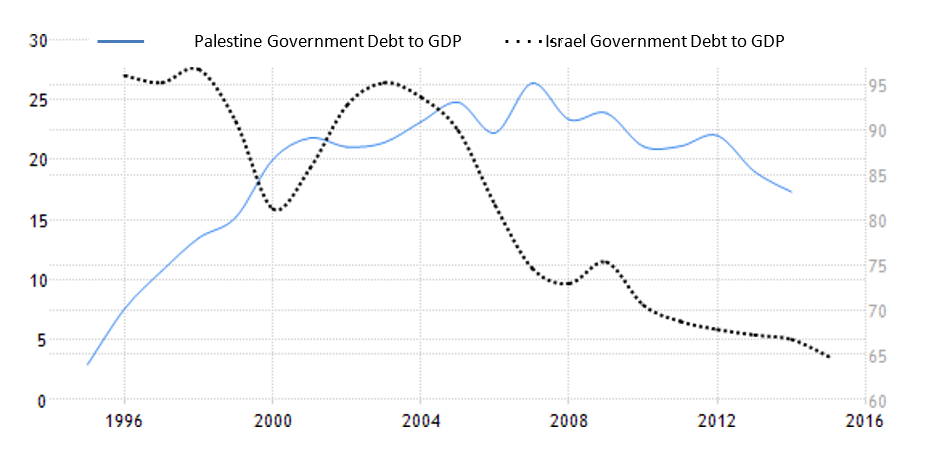
Figure 1
Palestine and Israel Government Debt to GDP (1995-2015)
Sources: https://tradingeconomics.com/palestine/government-debt-to-gdp
The concept of a low government debt-to-GDP ratio states that a country's economy produces and sells goods and services in a sufficient manner that allows the government to pay off debt without incurring more debt. As the previous graph shows, the ratio of Palestinian government debt to GDP is very high compared to the Israeli government, due to the negative effects of the Paris Economic Protocol. The Palestinian Authority was dependent on foreign aid, and in any crisis or fluctuations, the government was unable to pay its debts. This was clear in 2000, when the Al-Aqsa Intifada began, and in 2006, when Hamas won the legislative elections. Both years saw a rise in debt. On the other hand, the Israeli government was able to exploit the Paris Protocol to improve its economic situation and reduce government debt, by paying all its expenses. Although it went through several crises, including the war on Gaza in 2008 and the Lebanon war in 2006, it was able to fight its wars and pay its debts at the same time.
The Palestinian Economy during the Extended Period (2000-2009)
During that period, important political developments took place on the ground, which affected the general character of the Palestinian economy (negatively in the case of turmoil and occupation practices, or positively in conditions of political stability) as follows .
The Events of the Al-Aqsa Intifada in 2000
In 2000, after seven years of the Oslo Process and more than five years after the establishment of the Palestinian Authority, per capita income in the Occupied Palestinian Territory was estimated to be around 10% below pre-Oslo Process levels. Despite significant external aid, living standards remain lower than before the trial began. The political situation has been exacerbated by Israel's ongoing policy of confiscating land and water, expanding settlements, restricting movement, and repeatedly violating key elements of the agreement with the Palestinian Authority.
After two years of political and security stability, which contributed to economic development, political turmoil occurred. The most important of them is the failure of the first round of negotiations between Israel and the Palestinian Authority at Camp David, which quickly reflected negatively on the Palestinian reality, as a mass Palestinian (intifada) to reject the repressive Israeli policies that led to the features of the Palestinian economy for subsequent years (Palestine Economic Policy Research Institute, 2013).
At the beginning of 2002, Israeli forces reoccupied the West Bank and imposed an absolute siege. The urban detention of more than 750,000 Palestinians turned into effective house arrest, and the economic recession turned into economic paralysis. Most of the remaining 1.25 million Palestinians in the West Bank are confined to their towns and villages, while freedom of movement for Gaza's 1.1 million residents is severely restricted. During this year, Israel imposed repeated large-scale attacks, reoccupations and curfews on the West Bank and Gaza Strip, further disrupting the economic and social activities of the vast majority of the population (Ajluni, 2003). The World Bank also estimates that, as of April 2002, Israeli forces had caused damage estimated at approximately USD 650 million to the physical infrastructure of the occupied Palestinian territories. More than half of this amount was the result of attacks in March and April 2002 on population centers in the West Bank.
Palestinian Housing Ministry reports also indicate that about 1,600 private homes were destroyed between 2000 and 2002, and about 14,000 homes were damaged, affecting about 95,000 people. This percentage applied to the United States would be approximately 8.5 million people affected. To this must be added the tens, if not hundreds, of millions of dollars in material damage to Palestinian public and private property in the second half of 2002. At the end of the second year of the Intifada, the gross national income (GNI) decreased by 38% from what it was in 1999. The real income of people was 46% less than it was in 1999, and 60% of the Palestinian people were within the circle of poverty (their income is less than USD 2.1). Total investment decreased by about 90% compared to 1999 in general GNI losses reached USD 5.2 billion after 27 months of the intifada (World Bank, 2003).
Economy within the Palestinian Division in 2007
Hamas won the legislative elections in 2006, and this led to an internal Palestinian division in 2007, and the Palestinian territories became administered by two governments (the Hamas government runs the Gaza Strip, and the Palestinian Authority runs the West Bank). Which contributed to the imposition of economic, social and humanitarian restrictions by the Israeli occupation under security justifications?
More than 2 million Palestinians in Gaza are «imprisoned», and the vast majority of them cannot access the other occupied territories and the outside world, limiting their access to health care, higher education, family and social life that Gaza cannot provide, and limiting opportunities for work and social life and economic opportunities. Movement restrictions imposed by the Israeli authorities since the early 1990s, which were tightened for security reasons after Hamas came to power in June 2007, have had a profound impact on living conditions in Gaza, undermining the unity of the Palestinian territories and its economic and social fabric (United Nations Office for the Coordination of Humanitarian Affairs, OCHA, 2022).
Restrictions on the entry of goods deemed «dual-use» items by the Israeli authorities, imposed due to security concerns, continue to undermine the quality of basic services and hamper efforts to meet housing needs. Limited access to critical construction materials and equipment since 2007 has delayed the construction, repair and modernization of homes and infrastructure needed to address high population growth and devastation caused by recurring hostilities. This has undermined the quality of health, education, water and sanitation services available in Gaza (Wafa Data and Information Agency, Main Economic Indicators from 1995-2014, December 26, 2020).
Economic and financial indicators show that during that period, the Palestinian National Authority received aid worth USD 1.3 billion, which constitutes 25% of GDP. As a result of the deterioration of the situation in the Gaza Strip due to the continued blockade, the negative effects have offset marginal improvements in the West Bank and left GDP growth at 0%. The flow of aid does not appear to have led to an increase in the productive capacity of the Palestinian economy but was only reflected in an increase in consumption. The ratio of consumption to GDP reached 144%, and the ratio of private consumption reached 104%. On the other hand, the ratio of investment to GDP fell to 22.2%, driven mostly by private investment (Palestine Monetary Authority, 2007) (Table 1).
The key Economic Indicators in Palestine during 1999 to 2007
|
|
|
|
|
|
|
|
|
|
|
|---|---|---|---|---|---|---|---|---|---|
| PA Population (Thousand persons) | 3,019 | 3,149 | 3,275 | 3,394 | 3,515 | 3,638 | 3,762 | 3,888 | 4,016 |
| Growth rate (%) | 4.2 | 4.3 | 4.0 | 3.6 | 3.6 | 3.5 | 3.4 | 3.4 | 3.3 |
| Of which: West Bank (Thousand persons) | 1,932 | 2,011 | 2,087 | 2,158 | 2,229 | 2,300 | 2,372 | 2,444 | 2,517 |
| Growth rate (%) | 4.0 | 4.1 | 3.8 | 3.4 | 3.3 | 3.2 | 3.1 | 3.1 | 3.0 |
| Gaza Strip (Thousand persons) | 1,087 | 1,138 | 1,188 | 1,236 | 1,286 | 1,338 | 1,390 | 1,444 | 1,499 |
| Growth rate (%) | 4.6 | 4.7 | 4.4 | 4.1 | 4.0 | 4.0 | 3.9 | 3.9 | 3.9 |
|
|
|||||||||
| GDP at constant prices (USD million) | 4,881 | 4,617 | 3,906 | 3,539 | 3,744 | 3,969 | 4,207 | 4,005 | 4,005 |
| Growth rate (%) | 8.9 | -5.4 | -15.4 | -9.4 | 5.8 | 6.0 | 6.0 | -4.8 | 0.0 |
| GDP per capita (USD) | 1,745 | 1,580 | 1,284 | 1,121 | 1,144 | 1,170 | 1,198 | 1,102 | 1,065 |
| Growth rate (%) | 4.4 | -9.4 | -18.8 | -12.7 | 2.0 | 2.3 | 2.4 | -8.0 | -3.4 |
| GNI at constant prices (USD million) | 5,845 | 5,447 | 4,354 | 3,956 | 4,217 | 4,414 | 4,712 | 4,478 | 4,461 |
| Growth rate (%) | 8.4 | -6.8 | -20.1 | -9.1 | 6.6 | 4.7 | 6.8 | -5.0 | -0.4 |
| GNI per capita (USD) | 2,089 | 1,865 | 1,431 | 1,253 | 1,288 | 1,301 | 1,341 | 1,232 | 1,186 |
| Growth rate (%) | 3.9 | -10.8 | -23.2 | -12.5 | 2.8 | 1.0 | 3.1 | -8.2 | -3.7 |
| GDP at current prices (USD million) | 4,517 | 4,442 | 3,746 | 3,156 | 3,624 | 4,077 | 4,478 | 4,533 | 5,045 |
| GNI at current prices (USD million) | 5,454 | 5,274 | 4,193 | 3,546 | 4,105 | 4,534 | 4,015 | 5,068 | 5,620 |
| Unemployment Rate (%) | 11.8 | 14.1 | 25.2 | 31.3 | 25.6 | 26.8 | 23.5 | 23.6 | 21.6 |
| Of which: West Bank | 9.5 | 12.1 | 21.5 | 28.2 | 23.8 | 22.9 | 20.3 | 18.6 | 17.7 |
| Gaza Strip | 16.9 | 18.7 | 34.2 | 38.0 | 29.2 | 35.4 | 30.3 | 34.8 | 29.7 |
| Inflation Rate (%) | 5.5 | 2.8 | 1.2 | 5.7 | 4.4 | 3.0 | 3.5 | 3.8 | 2.7 |
| Of which: West Bank | 6.5 | 3.2 | 2.6 | 6.1 | 4.3 | 2.9 | 2.9 | 4.0 | 2.5 |
| Gaza Strip | 4.0 | 3.0 | -1.2 | 2.3 | 2.5 | 3.2 | 1.2 | 5.1 | 4.1 |
| Consumption Expenditure as % of GDP | 122.5 | 125.8 | 136.6 | 140.9 | 138.9 | 142.2 | 143.1 | 145.6 | 144.0 |
| Investment Expenditure as % of GDP | 42.0 | 31.4 | 20.7 | 24.7 | 26.8 | 25.1 | 24.1 | 21.1 | 22.2 |
| Domestic Saving as % of GDP | 7.1 | 6.2 | 11.8 | 17.1 | 10.0 | 3.8 | 3.9 | 11.2 | 14.6 |
|
|
|||||||||
| Total Revenue and Grants (USD million) | 1,439 | 1,449 | 1,124 | 992 | 1,383 | 1,403 | 2,006 | 1,740 | 2,938 |
| As % of GDP | 31.9 | 32.6 | 30.0 | 31.4 | 38.2 | 34.4 | 44.8 | 38.4 | 58.2 |
| Of which: local revenues (USD million) | 942 | 939 | 275 | 295 | 763 | 1,050 | 1,370 | 721 | 1,616 |
| As % of GDP | 20.9 | 21.1 | 7.3 | 9.3 | 21.1 | 25.8 | 30.6 | 15.9 | 32.0 |
| Total Expenditure & Net Lending (USD million) | 1,411 | 1,668 | 1,437 | 1,251 | 1,651 | 1,528 | 2,281 | 1,707 | 2,877 |
| As % of GDP | 31.2 | 37.6 | 33.4 | 39.6 | 45.6 | 37.5 | 50.9 | 37.7 | 58.0 |
| Of which: Current Expenditure (USD million) | 937 | 1,199 | 1,097 | 999 | 1,256 | 1,528 | 1,994 | 1,426 | 2,567 |
| As % of GDP | 20.7 | 27.0 | 29.3 | 31.7 | 34.7 | 37.5 | 44.5 | 31.5 | 50.9 |
| Public Debt (USD million) | 391.5 | 794.8 | 1,190.6 | 1,089.6 | 1,235.8 | 1,421.8 | 1,602.2 | 1,493.8 | 1,439.4 |
| As % of GDP | 8.7 | 17.9 | 31.8 | 34.5 | 34.1 | 34.9 | 35.8 | 33.0 | 25.5 |
| As % of Total Exports | 43.9 | 91.7 | 212.6 | 234.3 | 266.3 | 265.3 | 272.5 | 279.2 | 216.1 |
|
|
|||||||||
| Current Account (USD million) | -1,577 | -1,119 | -334 | -241 | -609 | -870 | -906 | -448 | -383 |
| As % of GDP | 34.9 | 25.2 | 8.9 | 7.6 | 16.8 | 21.3 | 20.1 | 9.9 | 7.6 |
| Export of Goods and Services (USD million) | 892 | 867 | 560 | 465 | 464 | 535 | 588 | 535 | 666 |
| As % of GDP | 19.7 | 19.5 | 14.9 | 14.7 | 12.8 | 13.1 | 13.1 | 11.8 | 13.2 |
| Import of Goods and Services (USD million) | 3,805 | 3,404 | 2,705 | 2,535 | 2,844 | 3,279 | 3,598 | 3,558 | 4,005 |
| As % of GDP | 84.2 | 76.6 | 72.2 | 80.3 | 78.5 | 80.4 | 80.3 | 78.5 | 79.4 |
| Income from Abroad (USD million) | 937 | 832 | 447 | 390 | 481 | 457 | 537 | 535 | 575 |
| As % of GDP | 20.7 | 18.7 | 11.9 | 12.4 | 13.3 | 11.2 | 12.0 | 11.8 | 11.4 |
| Of Which: Comp. of Employees (USD million) | 887 | 784 | 389 | 223 | 269 | 261 | 337 | 386 | 475 |
| As % of GDP | 19.6 | 17.7 | 10.4 | 7.1 | 7.4 | 6.4 | 7.5 | 8.5 | 9.4 |
| Current Transfers (USD million) | 399 | 586 | 1,364 | 1,439 | 1,290 | 1,417 | 1,567 | 2,040 | 2,381 |
| As % of GDP | 8.8 | 13.2 | 36.4 | 45.6 | 35.6 | 34.8 | 35.0 | 45.0 | 47.2 |
| Capital and Financial Account (USD million) | 1,542 | 1,210 | 318 | 256 | 710 | 897 | 932 | 470 | 474 |
| As % of GDP | 34.1 | 27.2 | 8.5 | 8.1 | 19.6 | 22.0 | 20.8 | 10.4 | 9.4 |
| Change in Foreign Assets | -35.0 | 91.0 | -16.0 | 15.0 | 101.0 | 27.0 | 26.0 | 22.0 | 91.0 |
During the Period 2008
A period of relative peace, private savings increased as foreign aid increased and consumption remained stable. During conflict years on the other hand (2003-2005 and 2008 onwards), although foreign aid inflows continued, private savings declined. After 2009, persistent conflict and reduced foreign aid flows forced private agents to complain and adjust consumption to a lower level. Therefore, it seems that the conflict in Palestine has a more significant negative impact on savings (compared to other conflict countries with higher savings) despite the large foreign transfer.
Economy Palestine from 2010 to 2019
The GDP in Palestine declined in 2014 by 0.4%, which was less than the recovery period during the period 2009-2013, and it reached a peak of 12.4% in 2011, gradually declining to 2.2% at the end of the recovery period, the main reason for the sudden decline. In the gross domestic product in 2014 is a sharp decline in its value in the Gaza Strip, where its value decreased by 15.2% due to the war on the Gaza Strip in July 2014 and the ensuing stifling blockade that contributed to the destruction of the infrastructure, especially the construction sector and the industrial sector. The estimates indicated that the rate of GDP growth in Palestine was stable and stable in 2019, reaching 0.9% compared to 2018, which reached 1.2%, despite the financial, economic and political crisis that Palestine witnessed during the year 2019, which witnessed the Israeli occupation carving part from the tax revenues from the clearance due to the Palestinian government paying salaries to the families of the prisoners, martyrs and the wounded, which led to the Palestinian government’s refusal to receive incomplete revenues and thus for its seizure of clearance funds for more than six consecutive months, as the Israeli occupation collects these revenues on behalf of the Palestinian government according to the Paris Economic Protocol. All this led to problems with cash liquidity and an accumulation of government obligations to public sector employees and private sector suppliers, which negatively affected public spending (Palestinian Central Bureau of Statistics, 2015, 2018, 2020).
As for the activities of the economic sectors, the services and construction sectors recorded the highest growth in value added at the end of 2012, where the services sector reached USD 13,656 million, followed by the construction sector with USD 955.1 million. The services sector continued to have the highest percentage of contribution to the domestic product. Total, up to the year 2019, where its added value reached USD 5,266.3 million, meaning that its contribution to the GDP amounted to 46.8%. As for the wholesale and retail trade sector, it reached USD 2,760.0 million in 2015, and the growth in the added value of that sector accelerated to USD 3,372.0 million in 2019 As for the industrial sector, it is the third largest in the amount of its contribution to the GDP, as it contributes 14 percent, and the least contributor to the GDP of the Palestinian economy is the transport and storage sector, where it contributed only 3.6% in 2017 and 3.1% in 2019 (economic performance, 2010-2019).
In 2016 the unemployment rate was 18.2% in west bank, 42% in Gaza strip and in occupied Palestine territory it was 27% , more than twice regional average in addition, the percentage unemployment rose about 0.2% in 2018 compare with 2019 (United Nations Conference on Trade and Development, 2020).
On other hand, the population of Palestine, according to the 2017 census, reached 4,781,248 individuals distributed in the Gaza Strip, 1,899,291 individuals, and in the West Bank, 2,881,957 individuals, and that census represents an increase from the 1997 census, approximately 65.1%. While the population of Palestine in 2020 reached 5,101,152, an increase of about 247,139 people over what it was in 2018 (Palestinian Central Bureau of Statistics, 1997-2021 https://www.pcbs.gov.ps).
Chapter Two. The Palestine Insurance Sector
Introduction
In light of this new climate, countries have taken a special interest in the insurance sector, and have made great strides in liberalizing the insurance industry, and subjecting it to a free market economy with the development of regulatory systems and laws with the aim of providing the appropriate climate and exploiting the profit surpluses of the large savings accumulated in the insurance sector, so that this sector has become a constituent (important part of the development for the society). Essential in driving the economic growth of these countries, especially.
Those that do not possess natural sources of wealth. Due to the challenges and complexities of modern life, and the increasing losses in property and lives, the view on the concept of insurance has gone beyond the economic and commercial dimension, and has become more comprehensive towards the social dimension to ensure the stability of institutions and individuals and as a safety and protection factor for the family, and to confront the dangers that threaten the profitability and expansion of companies (Abdeljawad, et al., 2020).
As a result of the reports of the Swiss Sigma institution, which stated that the insurance sector activity was much more than its growth in developing countries and the increase in demand for life insurance and commercial activities, which contributes a large percentage to the domestic product (GDP) of these countries significantly (Sigma, 2017, 2020). The Sigma institution confirms in its statistics that 96% of the global insurance sector is confined to developed countries as a result of the huge projects that are active in these countries, as well as the people's culture towards insurance of all kinds, especially life insurance. On the other hand, the Middle East region constitutes less than 1% of global insurance premiums in 2015 compared to 2014 (Palestine Economic Policy Research Institute, 2016a). In this book, we will deal with the insurance sector in Palestine, explain the historical stages in it, and explain all its aspects and the challenges it faces.
History of Palestinian Insurance
And because the Palestinian economy is submitting under occupation, we cannot talk about it without linking it to political events that it has been subjected to, and since the insurance sector is part of the Palestinian economy, so we will summarize its historical events in the following two phases.
The Reality of the Insurance Sector before the Establish of the Palestinian Authority in 1994
Insurance activities in Palestine were very limited before 1994, therefore, the Palestinian insurance sector is a relatively new one when compared to other sectors (Palestine Export Strategy, Financial Services, 2014). The first insurance company was established in 1944 by the Arab Bank, and its name was the Arab Insurance Company, and it was managed by the Palestinians after 1948 war the company moved its business to Lebanon and became a Lebanese company. During that period insurance was practiced in the West Bank through branches of Jordanian and foreign insurance companies and agents. As for the Gaza Strip, it was practiced through branches of Egyptian insurance companies. After the Israeli occupation of 1967, and up to year 1975, the size of the market remained very small and insurance companies were branches of Israeli companies or agencies of foreign companies.
In 1975, The Arabia Insurance Company was established and had USD 1 million in capital, but it was not operating alone in the market and faced competition from Israeli insurance companies and some agencies of foreign insurance companies, and this situation continued until the outbreak of the first intifada in 1987, which forced Israeli insurance companies to withdraw from the market and left the Arab Insurance Company alone in the market. However, this monopoly ceased when two new insurance companies were established in 1993. These companies are the Al-Mashreq Insurance Company (MIC) and the National Insurance Company (NIC).
The Reality of the Insurance Sector after the Establish of the Palestinian Authority in 1994
In 1993, the Palestinian National Authority began supervising the insurance industry, and expanded the geographical scope of its responsibility to the sector in 1994, and in accordance with the Powers Transfer Agreement, the Authority became the legally authorized and supervisory body in the field of insurance, including licensing the insured and agents, and supervising their activities, and maintained Palestinian laws provide for a fully compulsory compensation system for road victims, and after the Palestinian Authority acquired the insurance sector through the Ministry of Finance, it allowed some Arab and foreign insurance companies to operate in Palestine, as the number reached nine companies registered with the Ministry of Finance (Palestine Economic Policy Research Institute, 2016b).
Despite this remarkable development, the sector has now suffered from the absence of legislations and mechanisms for governmental supervision and control, work chaos and weak insurance confidence for a long time until the establishment of the Palestinian Capital Market Authority (PCMA) and it became the legal body. A body licensed to supervise, regulate and control the sector’s business at the end of 2004, and the issuance of Insurance Law No. 20 of 2005 helped reorganize the insurance sector. The Authority, as the legally authorized body and through the General Administration of Insurance, has set detailed policies aimed at developing and developing the insurance sector, preparing the necessary regulations, and providing the appropriate environment for the growth and advancement of the insurance industry. Public benefit for general economic activity in Palestine, in cooperation and coordination with the concerned authorities, and it is also working continuously to develop plans to ensure the development and organization of the insurance sector and to spread insurance awareness among members of society, in cooperation with all components of the insurance sector.
Importance of Insurance Sector
The insurance sector is considered one of the vital sectors that make up the modern economy of any country around the world due to the importance of its role in financial intermediation between different economic units, which contributes to achieving economic efficiency (Abdul-Gawad, 2020). By facilitating the transfer of funds, compensating for financial losses, and reducing the uncertainty faced by individuals and companies, these funds are invested in government securities and stocks. This process increases the development of the economy of each country, and insurance contributes to protecting the owners of economic projects from risks that lead to high commodity prices, which contributes to raising the cost of the commodity, which is one of the factors. From the macroeconomic balance, the insurance sector plays an important role in raising the value of GDP. By increasing its investments and pushing forward development, the Palestinian insurance sector succeeded in raising the ratio of premiums to GDP to 9.6% in 2020, compared to 2019.
The Importance of the Insurance Sector in Palestine
The insurance sector in Palestine is considered one of the most prominent economic sectors as a protective shield for various segments of society through its vital role in compensating for losses and damages that may befall the insured (companies, individuals) (Assad, 2014). The importance of the insurance sector in Palestine is highlighted by its rapid growth. The insurance sector achieved a growth during the year 2019 over its predecessor, amounting to about 8.3%, and the insurance portfolio reached USD 302.5 million at the end of the year 2019, which contributed to the increase in various investments in the economy that led to an increase in Palestinian GDP, where the insurance penetration rate at the end of the year 2019 (the total insurance portfolio is attributed to the total GDP at current prices) was 1.9%, and the insurance density, which refers to the per capita share of the total insurance portfolio at the end of the year 2019, was USD 60.
The insurance sector also contributed to providing job opportunities through the increase of companies registered in the Palestinian Capital Market Authority, which led to the spread of branches in various Palestinian geographies, where 1,178 employees worked in 2016 in 122 branches and as a result of the tangible development in the insurance industry in Palestine, the number of employees increased to 1,500 employed in the first quarter of 2020 (2019).
Statistics and Indicators Palestine Insurance Sector
Insurance Services Penetration Rates
The contribution of the insurance sector to the GDP is still modest despite the remarkable development over the past decade, and the contribution of insurance to the GDP is still modest, registering 1.9% in 2019, although this percentage has grown over the past five years. On the other hand, insurance density, which measures a person’s share in the total insurance portfolio, has grown over the past five years, reaching USD 60 at the end of 2019 (table 2).
It should be noted that the insurance penetration rate (1.9%) in Palestine is higher than the penetration rates in Egypt, Kuwait, Algeria and Saudi Arabia. On the other hand, the insurance density (USD 60) is much less than in the Emirates, Saudi Arabia, Kuwait and even Jordan (Economic Monitor, 2019).
Insurance Services Penetration and Density Rates (2015-2019)
|
|
|
|
|---|---|---|
| 2015 | 1.3 | 37.1 |
| 2016 | 1.4 | 44.1 |
| 2017 | 1.6 | 53.4 |
| 2018 | 1.7 | 56.8 |
| 2019 | 1.9 | 60.0 |
Source: Capital Market Authority, Annual report, 2019.
The Percentage of Change in the Components of the Insurance Portfolio
The insurance sector has witnessed a remarkable growth compared to the past ten years. That is, from the end of 2009 until the end of the year 2019, a growth rate of 19% annually, as the insurance portfolio increased 104.3 - 302.5 million USD during this period (table 3).
The insurance portfolio (2009-2019)
|
|
|
|
|
|---|---|---|---|
| Total motor insurance premiums | 60,551,846 | 204,246,742 | 237.3 |
| Total health insurance premiums | 16,816,966 | 35,119,320 | 108.8 |
| Total Fire Insurance Premiums | 6,822,880 | 14,288,928 | 109.4 |
| Total marine insurance premiums | 1,094,914 | 1,885,616 | 72.2 |
| Total life insurance premiums | 2,931,514 | 6,278,096 | 114.2 |
| Total workers’ insurance premiums | --- | 24,851,968 | --- |
| Total engineering insurance premiums | --- | 6,074,106 | --- |
| Total civil liability insurance premiums | --- | 4,387,383 | --- |
| Total other general insurance premiums | --- | 5,376,909 | --- |
| Total general insurance premiums * | 16,086,274 | --- | --- |
| Total insurance premiums | 104,304,394 | 302,509,068 | 190.0 |
* Starting with the data for the year 2011, the general insurance item has been broken down into (workers, liability, engineering, and other general insurances).Source: Capital Market Authority, Annual report, 2019.
It is noted above:
During the ten years, motor insurance dominated the largest contribution to the financial portfolio, exceeding USD 204 million at the end of 2019, followed by health insurance with its share of USD 35 million, while the share of marine insurance from the total premiums. It was the lowest, at USD 1.8 million.
Market Concentration
Insurance products (motor, health, and workers) continued to maintain the largest share of the insurance sector for the last four consecutive years, and the highest share was the motor sector, as its share at the end of 2019 reached 67.5%, followed by health insurance at 11.6%. Third place at the top of the share of worker insurance is 8.5%, As for the other insurance sector, it remained stagnant in its small share of the insurance sector’s portfolio, as shown in figure 2.
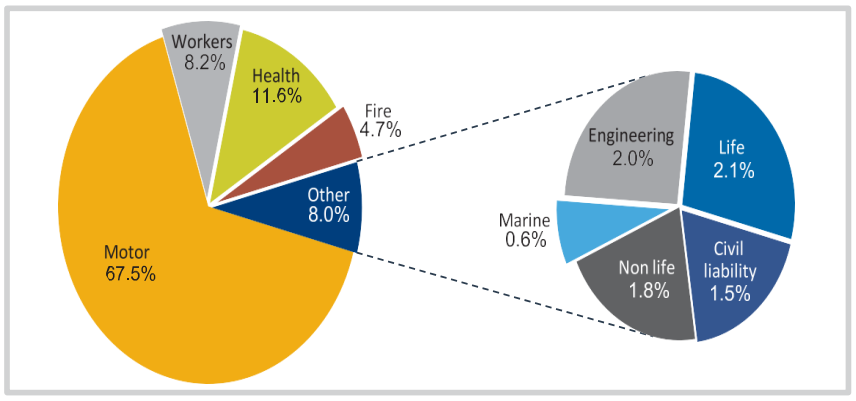
Figure 2
Total Insurance Portfolio per Product as it is on December 31, 2019 (Total Value of USD 302.5 million)
Source: Capital Market Authority, Annual report, 2019.
From an investment perspective, life insurance is the most valuable due to its long-term investment potential, while auto insurance is the least profitable, as its investment potential is limited to short-term instruments such as certificates of deposit. There is great potential in the Palestinian insurance sector to expand the penetration of life, housing and civil liability insurance, and to introduce new insurance products, such as medical malpractice, critical illness, and other professional liability coverage. The potential of Islamic insurance products remains largely untapped (Palestine Export Strategy – Financial Services, 2014).
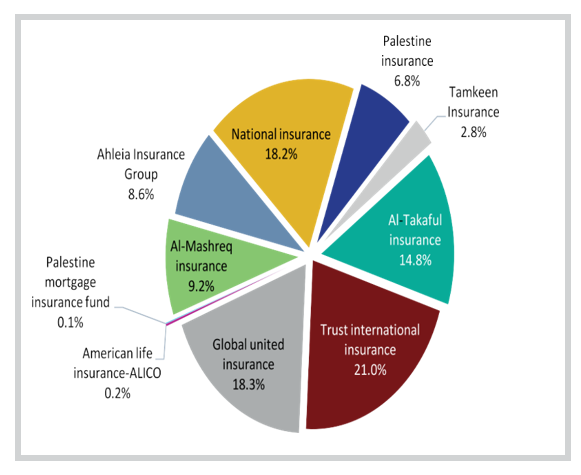
Trust International Insurance Company obtained the highest share in the insurance sector portfolio in the years 2019 and 2018, but at a lower rate in 2019 by 2% than the previous year, and Trust Insurance Company contributed with National Insurance and Global United Insurance Company to more than 57% of the shares of the insurance bench in Palestine in 2018 and the rest of the cake was shared among other companies with less shares, while that percentage of companies combined in 2019 was 16% less than it was in the previous year as shown in figures 3 and 4.
Figures 3 and 4
Total Insurance Portfolio for each Company in 2018 and 2019
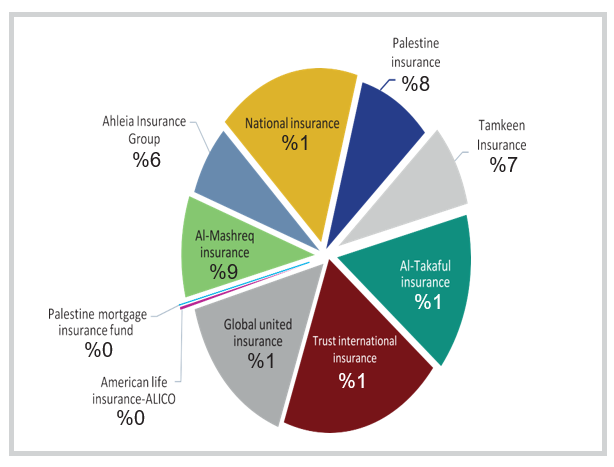
2018 (total value of USD 279,370,598) 2019 (total value of USD 302.5 million)
It is noticeable, the insurance portfolio is still witnessing a large concentration in favor of vehicle and health insurance for the last four years, and there is also a concentration in market shares, as three out of ten companies registered in the Palestinian Financial Market Authority obtained more than half of the market shares.
The Obstacles Facing the Palestinian Insurance Sector
The Palestinian insurance sector is characterized by its high importance as it is an important part in the financial sector, which is the main engine of the Palestinian development process, as well as its role in protecting the Palestinian national wealth and preserving public and private property (Al-Rimawi, 2019).
In order to maintain its effective role in the Palestinian economic system and to carry out an effective cycle and its development and growth, the obstacles it faces in order to address them and reduce their effects must be identified, and the most prominent challenges that have been monitored can be presented, which are:
-
The lack of an insurance culture in private and public institutions, as well as individuals who view insurance services as a luxury, and the absence of full awareness of the importance and benefits of insurance products (Assad, 2014).
-
The economic level, limited income and high unemployment rates are one of the main determinants of the demand for insurance. When insurance premiums are relatively high, the poor and middle classes cannot afford to buy insurance policies, as the largest part of the business sector in Palestine is small and medium (more than 90%). Negatively affects the increase in the demand for insurance. This is another challenge, especially in the light of economic instability (Palestine Economic Policy Research Institute, 2016a).
-
Lack of qualified human resources in the field of religiosity and its management as a result of its unavailability in Palestinian societies.
-
The contradiction between the quality of services and prices in the presence of intense competition, so raising prices is contingent on providing better services, and in return there is competition led by prices, and in the event of a price increase, the company is financially affected, and its market share decreases (Palestine Economic Policy Research Institute, 2016a).
-
Most of the laws and regulations have become outdated and do not keep pace with the progress and development in the sector and thus constitute a legal obstacle for insurance companies.
Institutions Regulating the Work of the Insurance Sector in Palestine
Palestinian Capital Market Authority (PCMA)
Historical Overview
Established on the basis of Article No. 2 of the Capital Market Authority No. 13 for the year 2004, the Palestine Capital Market Authority is a body corporate enjoying financial and administrative autonomy as well as the legal capacity to undertake all businesses and actions that ensure the fulfillment of its objectives including the acquisition of movable and immovable property necessary for the conduct of its work and the exercise and disposal of its activities in accordance with the provisions of the Law (https://www.pcma.ps/, 2021).
Objectives of the Authority (2016-2020)
-
Strengthening Insurance sector through restructuring and organizing its status in a manner that contributes to the sector's stabilization and growth.
-
Stimulating and deepening the securities sector and raising society awareness regarding the importance of investment in securities sector.
-
Create an enabling environment for the work and growth of the mortgage finance sector.
-
Develop services provided by financial leasing sector and raise its contribution to the economy.
Palestinian Federation of Insurance Companies (PIF)
Overview
The Palestinian Insurance Federation (PIF) is a non-profit organization and an independent legal entity that aims to enhance confidence in the Palestinian insurance industry while cooperating with the relevant official bodies and bodies associated with the insurance sector locally and internationally. The Public Investment Fund was established and has been in operation since the late 1990s. It gained its legitimacy in the Insurance Law No. 20, Issued in 2005 in Chapter Fifteen (https://www.pif.org.ps/, 2021).
Goals of (PIF)
-
Spreading insurance awareness and raising the literary value of work in the insurance industry.
-
Unifying and developing the professional foundations for insurance contracts of all kinds as much as possible and setting price tariffs represent minimum limits for all types of optional insurances in proportion to the degrees of risk and global prices for these insurances after the approval of the Capital Market Authority.
-
Coordination between insurance companies operating in the market, resolving disputes that may arise between them, and setting the necessary controls and regulations to achieve this.
-
Enhancing confidence in the insurance industry and achieving cooperation and coordination with the competent official authorities, and everyone involved in the insurance sector locally, regionally and internationally.
-
Participating in Arab, regional and international insurance unions, as well as other relevant bodies, and working to organize technical, administrative, legal and financial meetings in Palestine.
Chapter Three. Islamic Insurance (Takaful)
Introduction
The dangers surrounding human life in all its aspects and the negative effects they carry contribute to harm to individuals and groups. These risks contributed to forming a starting point for societies to search for a mechanism to reduce risks, which gives these communities the characteristics of stability and continuity. As a result of this innate behavior, these societies developed through their members to participate in the distribution of risks, as the Chinese merchants did before 3000 BC, when they distributed their goods in several boats, and in the event that one boat sank, most of the goods remained in the other boats, which contributed to the preservation. On the goods and the protection of merchants from being lost.
The Indians and Greeks developed insurance by adding a new type of insurance product, which is marine insurance, as they insured their cruises by borrowing. Funds from creditors to guarantee their ships to creditors in the event of non-payment. If a profit is made, the creditors take their money at a relatively high interest rate. If the merchants lose or a ship sinks, the creditors do not compensate for anything. Likewise, the Romans followed the example of others in making a new type of insurance (health, life) by establishing charitable societies that provide financial aid to the sick and elderly, and their soldiers have also been involved in health and disability plans (Nazarov & Dhiraj, 2019).
We notice that in every period of human history, the concept and philosophy of insurance was developed through the introduction of a new product or the adoption of a modern mechanism that contributed to keeping pace with insurance for all types of risks that humans face. Therefore, in this chapter, we will show Takaful insurance as a new Islamic philosophy in the concept of insurance, its mechanism of operation, and other aspects.
Growth History of Takaful Insurance
Among the ancient Arab tribes, a behavior aimed at protecting their members from the dangers that roamed around them. For example, if any of the tribe members committed a crime such as murder, a war would break out between them that sometimes lead to more deaths and tragedies. These grievances are mitigated by paying what is known as blood money to avoid further retaliation and tribal bloodshed. All tribe members contributed to the form of a donation to cover compensation funds for the victim's family, and this is known as the Aqila term, which ensures that risks are distributed among tribe members and compensate individuals who have suffered a loss (Nazarov & Dhiraj, 2019).
In the era of Islam, Aqila practices continued in Islam because of their positive effects on social solidarity and the Holy Quran confirmed and supported them Allah the Almighty said: «And help ye one another in righteousness and piety but help ye not one another in sin and rancour, and fear Allah for Allah is strict in punishment» (Qur’an, Surah al-Maidah, 5:2).
Furthermore, the Prophet (PBUH) also advised the Muslims to help one another to relieve hardships. As narrated by Salim: «And he who relieved a Muslim from hardship Allah would relieve him from the hardships to which he would be put on the Day of Resurrection…» (COMCEC, 2019). And Umar ibn al-Khattab (may God be pleased with him), the second caliph of the Muslims, established a scheme called «al-Qasbah» to pay compensation to those who were killed, in case the killer was able to be identified (Alhumoudi, 2012).
We conclude from the foregoing that the Qur’an and the Sunnah have contributed to enhancing cooperation and harmony among members of the Muslim community by encouraging them to do good deeds and leave everything that offends society. Also adopted all practices that existed before Islam that contribute to the payment of risks for the individual and groups such as Aqila that contribute all members of society in mitigating or preventing danger for an individual who may face it.
In 1956 the Islamic Research Conference in Cairo discussed the legitimacy of conventional insurance in the Islamic world. In 1976 in Makkah the first international conference on Islamic economics was held in the presence of more than 200 Islamic jurists, thinkers and economists to conclude that traditional insurance contradicts the principles of Islamic Sharia evil. In 1985 the Organization of Islamic Cooperation decided (OCD), «The commercial insurance contract with a periodic fixed premium provided by the current insurance companies is a void contract and therefore it is forbidden. According to the requirements of Sharia» and the cooperative insurance, Takaful was approved because it is ethical based on the principle of cooperation and assistance between members of society (Nazarov & Dhiraj, 2019).
In 1979 the first Takaful insurance industry was established in Sudan. After the Al Baraka Insurance Company, the Sudanese Sheikan Insurance Company and the National Cooperative Insurance Company. All were established in Sudan as a result of the enactment of the General Insurance Law in 1992, amended in 2003, which states that (all insurance companies workers in Sudan must adopt Islamic methods of insurance and reinsurance, especially on the basis of the agency model).
Concept the Takaful Insurance
Takaful is an Arabic word stemming from the verb «kafal», meaning to take care of one another's needs. It refers to a form of cooperative and joint insurance (COMCEC, 2019), defined by the International Islamic Fiqh Academy as a collective arrangement in which a group of individuals facing certain risks agree to each contribute a specified amount to a non-profit fund, based on the principle of mutual cooperation. This fund is subsequently used to compensate any member who suffers harm upon the materialization of the insured risk, in accordance with the signed contracts and applicable regulatory legislations (Swartz & Coetzer, 2010).
To clarify, the company specializing in Takaful insurance products does not own the premiums, but rather they go to the subscribers’ fund, and all returns are for them. The company takes its share of the profit through legitimate speculation. As for commercial insurance, the company directly receives the financial premiums paid by the insured, and they are subject to it. In addition, it was defined by Alhumoudi (2012) as an Islamic insurance system based on the principle of acceptable cooperation (mutual assistance) and donation (voluntary contribution), whereby risks are shared collectively by the group. This system is operated on the basis of shared responsibility, brotherhood, solidarity, cooperation or mutual assistance, providing mutual financial security and assistance to protect participants from specific risks.
Significance of Takaful Insurance
The importance of Islamic insurance is that it serves a wide range of Muslims around the world in accordance with the principles of the Islamic religion. At the same time, it offers benefits and services equivalent to its traditional counterpart. Therefore, takaful has evolved in response to the ever-increasing yearning for debt-based financing. The insurance consumers fulfill their religious beliefs and provide them with the desired risks coverage for individuals and international financial institutions. Islamic banks, their capital market, and insurance complement each other in the Sharia-compliant ecosystem (Swartz & Coetzer, 2010).
Taboo is at the Core of the Takaful Insurance Philosophy
In order for the concept of insurance not to violate the principles of Islamic law, it should be a distance from riba (interest), gharare (uncertainty) and maysir (gambling), which will be explained as follows:
-
Usury (riba): Is the growth or interest on the principal of the loan and increases likewise if the debtor delays in settling his debt after a specified period (Nazarov & Dhiraj, 2019). Dealing with usury is a form of injustice that leads to manipulation and exploitation, making the rich and impoverishing the poor. Usury, based on the principles of Islamic law, increases injustice by exploiting and manipulating people's need for money, which is inconsistent with Islamic values that are based on cooperation.
-
Uncertainty (gharar): It means deficit in clarity, deceit, ignorance, or ‘uncertainty’ in a business transaction over the terms, substance or attributes of the contract (Nazarov & Dhiraj, 2019). In order for the insurance contract to be valid in the teachings of Islam, it must be free from uncertainty or fraud. Prohibition of gharar can be deduced from the verse in Surat-An Nisa in the Holy Qur’an: «O you who have believed, do not consume one another's wealth unjustly but only [in lawful] business by mutual consent. And do not kill yourselves [or one another]. Indeed, Allah is to you ever Merciful» (Surat An-Nisa, Verse 29). Therefore, all terms and conditions must be clearly defined and defined for the parties involved in the business venture.
-
Gambling (maysir): It means betting, gambling or wagering. It may exist in the form of gharar since they are intertwined. To further clarify, if the customer makes a claim, the insurance company loses; and if there is no claim, the customer loses the premium he/she has paid. Majority Islamic jurists consider conventional insurance products to be Shari’ah non-compliant as it involves gambling. In takaful however, all terms and conditions are precisely defined. Game of chance and gambling are condemned by Allah (SWT) in the following verses: «They ask you concerning wine and gambling. In them is a great sin and some profit for man, but the sin is greater than the profit» (Surat Al-Baqarah, Verse 219).
Takaful Products
There are two types of Takaful insurance products:
General Takaful
The Financial Services Board defines general takaful as «plans that are essentially joint guarantee contracts on a short-term basis (usually for one year) and provide reciprocal compensation if a certain type of loss occurs». The schemes are designed to meet the protection needs of individuals and corporate bodies in relation to material loss or damage resulting from a disaster or disaster on real estate, assets or property of the participants (Salman et al., 2015).
The insurance company is trusteeing the custodian of the funds by investing and managing it using Islamic methods and directs the money to the investment fund after paying the various investment expenses through settling all liabilities and then transferring part to the reserves fund, as the figure 5 shows:
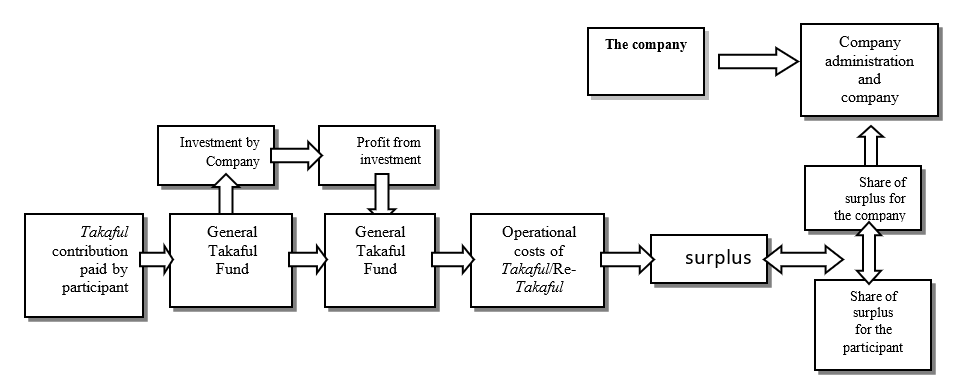
Figure 5
Operation General Takaful
The process of General Takaful contract
It is also noticeable that the surplus profits are shared between the company and the participants based on the agreement concluded between them and, In the event that the sum of the insurance premium and investment income is insufficient to meet these adjustments, the affected persons may be evaluated for additional contributions (Alhumoudi, 2012).
Family Takaful
Family Takaful insurance contributes to protecting the family from the various risks they face and achieving investment opportunities by obtaining various products for Takaful insurance, which reduces the financial burden of the family during risks and will increase the accumulation of return on investment. Another side (Salman et al., 2015).
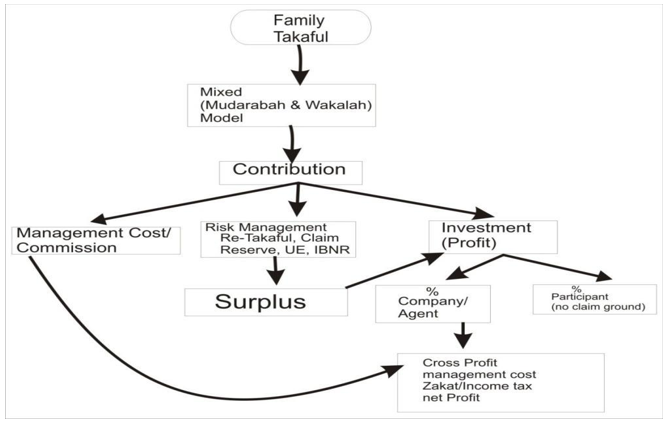
Figure 6
Operation of Family Takaful
Looking at the figure 6, using investment as a methodology, the takaful operator (the insurance company) agrees to the premiums in two separate accounts —the individual account and the private account for each insured party—. Takaful insurance companies then invest these funds in individual and private accounts in the form of mutual funds, consisting mainly of shares in financial institutions and manufacturers, as long as their goods and services are permitted by Islamic law.
Operation Models
These models illustrate the business philosophy of Takaful, discuss operating models, and illustrate the relationship between donors (participants) and companies through the diagrams that we will display in each operating model. But before diving into the depths of the various forms of Takaful insurance, we must explain the mechanism of Takaful insurance through the following form (figure 7):
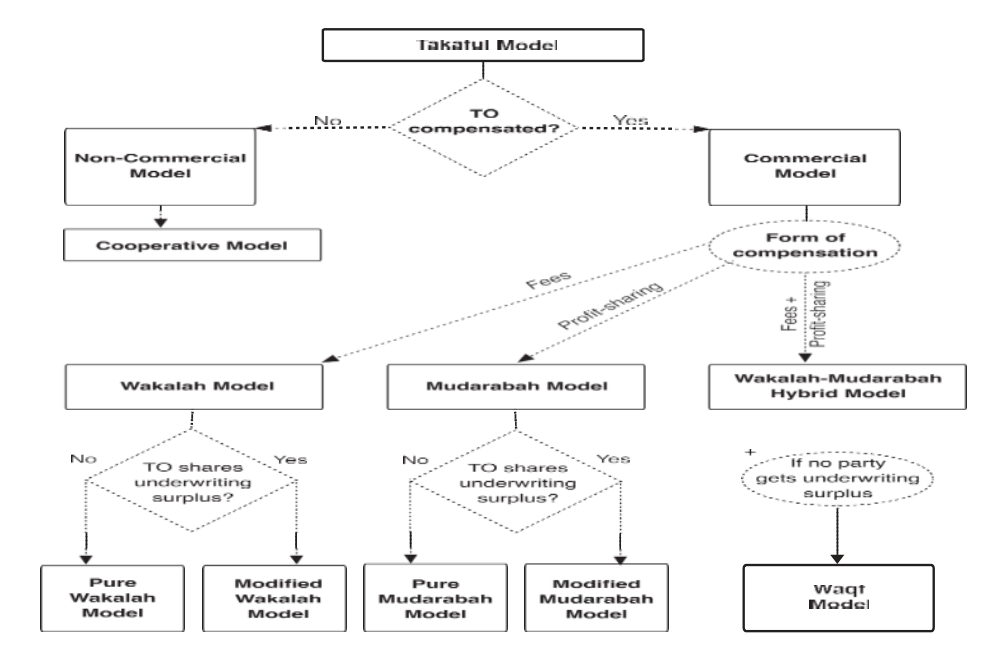
Figure 7
Classification of Takaful Business Models
Adherence to the rules of Islamic law is the most important condition in the takaful insurance and the takaful system consists of the operator and the participants and the contract that brings together members depends on donations from the participants (Nazarov & Dhiraj, 2019). Through the previous figure, three different models of takaful insurance can be monitored, each model has a different philosophy from the other, depending on how the takaful operator (TO) is compensated. Therefore, each model is identified by identifying the following aspects:
-
Relationship between participant and TO.
-
Participants' rights and obligations and TO.
-
Who pays the expenses incurred during the term of the contract?
-
How is the surplus distributed between the two parties? (Swartz & Coetzer, 2010)
The Mudarabah Model
The Accounting and Auditing Organization for Islamic Financial Institutions defines speculation (AAOIFI) as partnership in profit whereby one party provides capital, and the other party provides labor. Any profit is shared between the capital provider and manager in accordance with a profit-sharing ratio agreed upfront. Any financial loss will be borne solely by the capital provider, unless the loss is due to the manager’s negligence (taqsir), misconduct (ta’addi), or a breach of terms (mukhalafahal-shurut) (https://aaoifi.com/).
Profit in takaful is defined as returns on investment and surplus from underwriting in relation to takaful funds only. This does not include profits that were recorded by the shareholders’ fund, and administrative expenses are borne by the shareholders’ fund and not the takaful fund (Khan, 2016). The surplus is shared between the participants with a takaful operator. The share of such profits (surplus) may be in a ratio of 5:5, 6:4 etc., as mutually agreed between the contracting parties. Generally, these risk sharing arrangements allow the takaful operator to share in the underwriting results from operations as well as the favorable performance returns on invested premiums. As shown in figure 8:
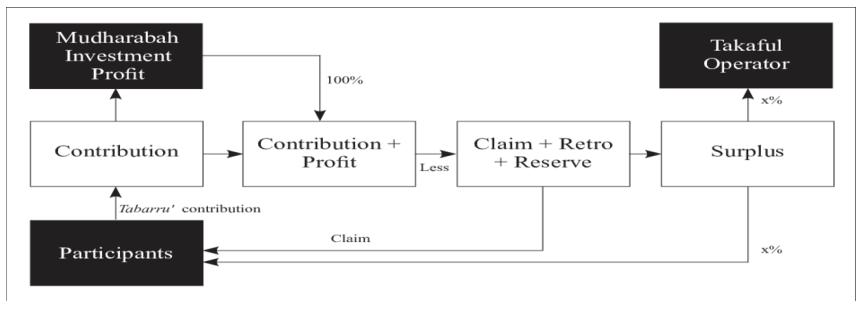
Figure 8
The Mudarabah Model
Wakala Mode
The term «wakalah» in Arabic means agency (COMCEC, 2019). As for the concept of the agency contract, as Abdul Rahim (2017) explained, a person delegates his work to another person to work on his behalf, and that person is responsible for performing his duties that have been assigned to him through his knowledge, experience and skills. In the agency form, the Takaful Company is the agent (the one in charge of shareholders' actions) for an agreed fee. In this model, the participants remain the actual owners of the takaful fund into which the contributions are pooled. Then the agent manages this fund on the basis of the principles of mudaraba and tabarruh, as shown in figure 9:
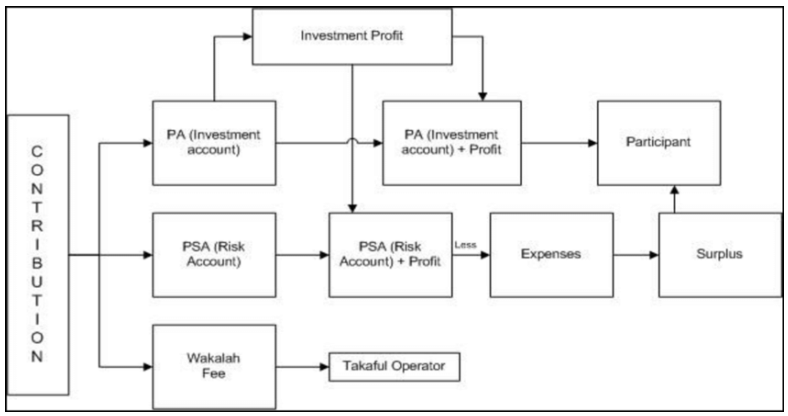
Figure 9
Wakala Model
Also, the surplus of policyholder funds and investments —net of management fees or expenditures— goes to policyholders (Alhumoudi, 2012).
Hybrid Model (Wakalah – Mudarabah)
The relationship between the Takaful operator and the participants in this model is controlled by the characteristics of mudarabah and takaful together, meaning that the company is considered mudarabah and an agent at the same time and therefore the company gets its percentage as mudarabah and also gets agency fees as shown in figure 10:
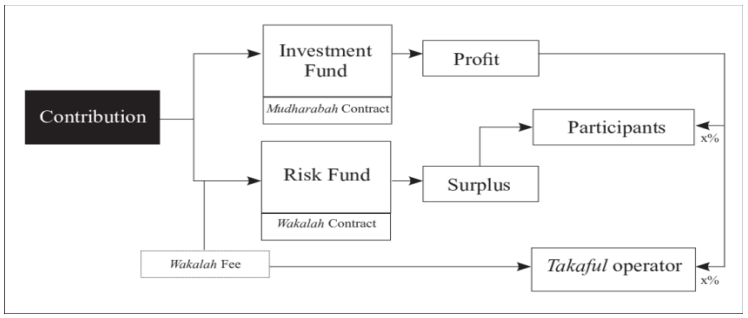
Figure 10
Hybrid Model
In this model:
-
The participants contribute to the Takaful fund through tabarru' contract.
-
The participants appoint the TO as agent and mudarib.
-
The TO will deduct up-front fee which is called the wakalah fee to manage the fund (COMCEC, 2019).
Global Islamic Takaful Landscape
In the early seventies, Islamic countries were interested in providing financial services in accordance with Islamic law including Islamic insurance (Al-Amri & Hossain, 2015), and as a result of this interest, financial services developed and spread in different parts of the world, with the total assets of Islamic financial services amounting to USD 2.5 trillion in 2019 compared to USD 1.7 trillion. In 2012, the Gulf countries contributed the largest share of these Islamic services (USD 1.2 trillion).
The growth of Takaful insurance as an important product for Islamic financial services and the Kingdom of Saudi Arabia topped the largest contributor to the Takaful insurance USD 17 billion in the value of the assets, 37 Takaful operators, followed by Iran and Malaysia, where these three countries constitute 80% of the total assets of takaful (ICD-REFINITIV, 2020).
Despite the positive growth of the services provided by the Takaful insurance (10%) in 2019, the Takaful insurance still constitutes only 2% of the assets of Islamic financial services, and this is due to several reasons, including:
-
Impaired insurance awareness: The lack of awareness of the insurance products presented by the Takaful insurance market has contributed to reducing the spread of the services it exports, especially in the Islamic community, which is about two billion people. For example, in Nigeria and Indonesia, the insurance penetration rate was only 5% despite the large population density.
-
Lack of adequate human resources: the Islamic insurance sector suffers from a weak human resource that has the technical skills as well as the knowledge related to the Islamic insurance tools, which causes a large deficit in the management and organization of these institutions.
-
Poor research and development: In 2019, there were only 397 holders of specialized degrees in Islamic finance, and the number of published research papers on Islamic finance between (2017-2019) amounted to nearly 2,500 research papers. Only 140 research papers discussed the issue of takaful insurance in 2019, and Malaysia topped the list of countries that published research papers during the period between (2017-2019) amounting to a 836-research paper.
Chapter Four. The Motors Insurance in Palestine
Types of motors insurance in Palestine
Vehicle insurance in Palestine is considered one of the most widespread insurances among other insurances, as the market share in 2019 reached more than 60%. As a result of the spread of car insurance in the Palestinian insurance market, car insurance has been divided into different types:
Compulsory Vehicle Insurance
It is compulsory insurance according to the law and is required for everyone who owns a vehicle that moves on the roads, and this type of insurance covers bodily damage to those injured in road accidents and the company is responsible for compensating the injured who are inside the insured vehicle, as well as the injuries caused the vehicle is for pedestrians on the roads, regardless of whether or not there is a fault on the part of the driver, and the liability of the insurance company for bodily injuries according to the law has an unlimited value, as it is responsible for:
-
Provide medical treatment for the injured person until he recovers fully or his disease condition stabilizes.
-
Compensation of the injured for all financial liabilities incurred as a result of the accident.
-
Compensation for the injured for the loss of temporary and permanent income that he may suffer as a result of the injury.
-
Compensate the injured for the psychological damage caused to him as a result of the injury (https://www.pif.org.ps/).
Liability Insurance Towards the Third Party (Third Party Insurance)
The word third party here means the third party, and this type of insurance covers the liability of the insured or the driver of the insured vehicle for material damage caused by this vehicle to others (the third party).
Complementary Insurance (Comprehensive Vehicle Body)
This type of insurance covers damages that may occur to the vehicle’s body as a result of a road accident, as this type of insurance comes to complement what is covered by compulsory insurance and third-party insurance (https://info.wafa.ps/).
Car Insurance Tariff
Compulsory Insurance Premium and the Third Party
The size of the premium is determined by the data for each vehicle as follows:
-
Private vehicles: the premium is determined by the engine power and divided into several segments.
-
Commercial vehicles: the premium is determined by the type of vehicle license, its load, and divided into several segments.
-
Public taxis: the premium is determined by the number of passengers in the vehicle and whether one or two drivers have been identified to drive the vehicle.
-
Private and public buses: the premium is determined based on the number of passengers and is divided into several segments.
-
Rental cars: the premium is determined based on the engine power of private cars or the load for commercial vehicles, considering the addition of an additional premium to the regular tariff and divided into several segments.
-
Heavy machinery: The insurance premiums are determined specifically to each machine.
Supplementary Insurance Tariff
The premium is calculated on the basis of a certain percentage of the car's value within a price table that has been determined according to the risks that the vehicle may face.
The Legal Environment for Vehicle Insurance in Palestine
The issuance of Insurance Law No. 20 of 2005 helped reorganize the insurance sector by clarifying the various policies for organizing and developing the insurance sector, and providing the appropriate environment for the growth of the insurance industry, especially that the insurance sector is newly established in comparison with some other sectors in the Palestinian economy (agricultural, industrial, etc.).
Therefore, vehicle insurance is one of the largest insurance products in the Palestinian insurance market (62%) in 2019, the insurance law obligated everyone who owns a car to obtain an insurance policy as mentioned in Article 137 of Chapter Sixteen, «No one may use Or allowing or causing another person to use a motor vehicle without a valid insurance policy in accordance with the provisions of this law».
The Insurance Law also separated into Chapter 17 about who is responsible for compensating the injured? Article 144 and Article 145 specify the responsibility to compensate the injured. The Insurance Law classifies the type of damage (immoral, material) that will compensate the person affected by the accident in Chapter 18.
Article 152 affirms that compensation for moral damage is as follows:
-
Fifty Dinars for every 1% of permanent disability.
-
Forty Dinars for every night the injured spends in a hospital or any other medical institution for treatment of damages caused by a road accident.
-
Five hundred Dinars for surgery or surgeries carried out on the injured as a result of a road accident requiring hospitalization.
-
Should a n injured person not be entitled to compensation under paragraphs (1, 2 and 3) of this article, said person shall be entitled to compensation not exceeding five hundred Jordanian Dinars or the equivalent thereof in the legal currency of the country.
The Insurance Law also specified in Articles 155, 156, 157, 158, 159 cases for which the injured person is financially compensated. Insurance Law No. 20 of 2005, Article 170 contributed to the formation of the legal environment for the establishment of the Palestinian Fund for Compensation for Victims of Road Accidents. Chapter Twenty of the Insurance Law, within Articles 170-177 and its amendments, especially the provisions of Articles 170 and 171 thereof, regulated the operation of the fund and its independent legal personality, and stipulated how its board of directors would be formed and determined its financial resources, and it indicated the right of the injured to demand compensation from the fund within conditions and controls It gave the fund the right to recourse the sums paid by it in accordance with the articles of the law (https://wvvw.sandoq.ps/).
Statistics and Indicators
Accidents
According to Palestinian police data, the number of accidents in the Palestinian governorates during the year 2019 reached 13,165, resulting in 10,846 injuries and 122 deaths. These accidents were concentrated in the governorates of Ramallah and Nablus, where their percentage was 27% in Ramallah, and 20% in Nablus governorate. The lowest incidents occurred in Qalqilya governorate, reaching 2%.
The results indicate the continued increase in the number of accidents during the previous years, as the largest number of accidents was recorded during the year 2019, reaching 13,165 accidents compared to 2018, which amounted to 12,829 accidents, as the figure 11 shows (http://www.mot.gov.ps/):
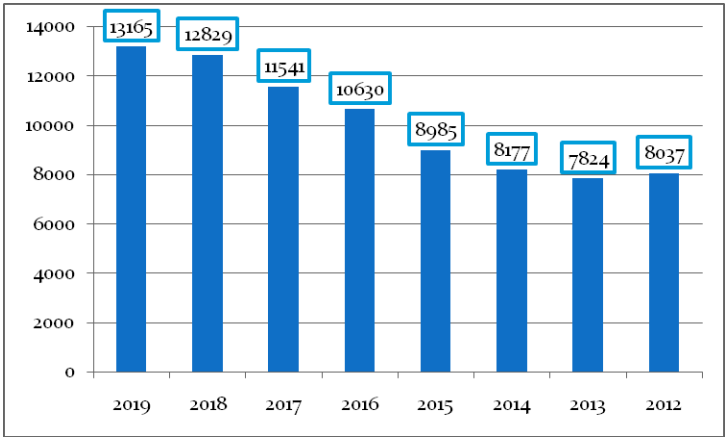
Figure 11
Number of Accidents in the Palestinian Governorates until the end of the Year 2019
Source: http://www.mot.gov.ps/
Number of Vehicles Registered
The number of licensed vehicles during the year 2019 in the West Bank reached 550,269 vehicles, where the highest percentage of licensed vehicles were private cars, accounting for 0.84% of the total number of licensed vehicles in the West Bank, followed by trucks and commercial cars, which amounted to 3.9%, followed by taxis. By 6.3%, while the remaining vehicles accounted for 1.3% (Palestine Statistical Book, 2020).
Number of Registered Vehicles (Below 2010-2019)
|
|
|
|---|---|
| Below 2010 | 168,928 |
| 2010 | 19,960 |
| 2011 | 16,983 |
| 2012 | 13,637 |
| 2013 | 12,378 |
| 2014 | 16,041 |
| 2015 | 19,586 |
| 2016 | 26,354 |
| 2017 | 32,925 |
| 2018 | 31,729 |
| 2019 | 27,335 |
| Total | 385,856 |
Source: http://www.mot.gov.ps/
Chapter Five. Towards the Development of Agricultural Insurance in Palestine in Considering the Challenges of Water and Land
Introduction
Palestine is located in southwest Asia on the eastern shore of the Mediterranean Sea. It is bordered on the east by the Jordan River and the Dead Sea, on the west by the Mediterranean Sea, on the north by Syria and Lebanon, and on the south by Sinai and the Gulf of Aqaba. Palestine has an arid climate and very limited water resources. The average annual precipitation in the West Bank is about 450 mm and 400 mm in Gaza. The population prospects of Palestine have increased demand on already low water reserves. In addition to climatic factors, Palestine faces an additional burden of political and economic challenges resulting from the Israeli occupation, which has negatively affected access to and management of water resources (Diabes-Murad, 2004; The Israeli Water Authority, 2012).
Water quality and quantity issues in Palestine have received the attention of local and international non-profit organizations, academic institutions and international development agencies such as the United Nations and the World Health Organization. These entities contributed significant resources to research and raise awareness about water conditions in Palestine. In its 2009 report, the Israeli human rights organization B'Tselem indicated that the Israeli occupation army destroyed water tanks and other infrastructure in various areas of the West Bank (Knesset Research Israel Center, 2018).
Accordingly, the reality of the Palestinian agricultural sector is not much different from the water sector due to the vital role of water in the agricultural sector, in addition to that it faces drought or frost, which are above the will and ability of the Palestinian farmer (Palestinian Central Bureau of Statistics, 2023a). All these risks facing the Palestinian agricultural sector necessitate the need to establish agricultural insurance that contributes to mitigating or avoiding the effects of these risks. In this research, we will focus on agricultural insurance in Palestine and discuss the details of the water and agricultural sector in Palestine (Barghouthi, 2009).
Brief of the Economy of Palestine
We cannot explain the behavior of the Palestinian economy and its indicators without mentioning the political situation and the historical events that the Palestinian people have endured. The Palestinian economic system was fragile and weak due to the consequences of the 1967 war. It was characterized by low rates of prosperity, low gross domestic product, low family income, low per capita income, high unemployment rates and frequent widening of poverty. All of them have posed serious challenges to economic development. In 1994, the Paris Economic Protocol was concluded between the Palestinian side and the Israeli occupation, with the important goal of «laying the foundation for strengthening the economic base of the Palestinian side and exercising its right to make economic decisions in accordance with its development plan and priorities». The protocol also aims to establish a «sound economic basis» for relations between the two views that the economic field represents «the cornerstone of their mutual relations».
Supporters of the agreement believe that to increase the freedom of the Palestinian market from some of the restrictions of the Israeli occupation. For example, it allowed Palestine to import petroleum products from countries other than Israel, and the Palestinian Authority was granted 75% of tax revenues, as well as exempting from paying any customs or taxes on the aid it receives from the supporting countries in order to develop non-commercial humanitarian projects. On the other hand, opponents of the Paris Protocol believe that Israel's policies have intensified, and it has not implemented what was agreed upon. Evidence for this is that the closure policy increased in the mid-1990s and imposed obstacles in front of Palestinian workers, which reduced their contribution to the Palestinian GDP, in addition to the systematic policies in destroying the various sectors of the Palestinian economy.
In 2007, the gross domestic product reached USD 5,505.8 million in 2007, which represents growth of 0.6% compared to 2006, which amounted to USD 4,910.1 million in 2007. While in 2008 there was a period of relative calm, private savings increased as foreign aid increased and consumption stabilized. However, during the period of conflict years (2003-2005 and post-2008 and beyond), private savings declined. The positive side was the continued flow of foreign aid.
The period from 2009 to 2013 was marked by economic stability and prosperity, which peaked in 2011 when the gross domestic product grew by 12.4%. This was largely due to the high growth rate in the Gaza Strip, which reached more than 17%, compared to 5.2% in the West Bank. The main contributing factors were the increase in international aid and grants for the construction sector in the Gaza Strip, which contributed to the GDP of 29.9%, while the services sector contributed by 30%. The labor force participation rate increased, rising from 41.1% in 2010 to 43.0% in 2011, with the number of workers in the Palestinian Territory reaching 837,000 workers in 2011, up from 744,000 in 2010.
However, the Palestinian political situation continued to affect economic growth until 2019, when the GDP growth rate in Palestine reached 0.9%, down from 1.2% in 2018. In 2020, the unemployment rate in Palestine increased to 27.2%, with the Gaza Strip having a rate of 46.6% and the West Bank 8.16%. Although the unemployment rate decreased slightly from 2019 to 2020, it remained a significant challenge for the Palestinian economy (Palestinian Central Bureau of Statistics, 2023b).
Insurance Sector in Palestine
The insurance sector is widely recognized as one of the most important contributors to a country's economy, as it provides a safety net for society’s human and material resources. Additionally, the insurance industry fuels economic development by channeling financial investments into societies.
According to reports by the Swiss Sigma Corporation, the insurance sector's activity has grown much faster in developing countries than in developed countries, with significant increases in demand for life insurance and commercial activities that contribute a large percentage to the Gross Domestic Product (GDP) of these countries. The Sigma Foundation's statistics confirm that 96% of the global insurance sector is concentrated in developed countries, primarily due to the large-scale projects and the culture of insurance prevalent in these countries, particularly in the area of life insurance. In contrast, the Middle East region accounted for less than 1% of global insurance premiums in 2015.
Since the Palestinian economy is currently under occupation, it is impossible to discuss it without examining the political events that have impacted it. As the insurance sector is a component of the Palestinian economy, we will provide an overview of its historical developments in two phases: before and after the establishment of the Palestinian Authority in 1994.
The Insurance Sector Before the Establishment of the Palestinian Authority in 1994
Insurance activities in Palestine were limited before 1994, making the Palestinian insurance sector a relatively new addition compared to other sectors. During this time, insurance was offered in the West Bank through branches of Jordanian and foreign insurance companies and agents. In the Gaza Strip, insurance was provided by branches of Egyptian insurance companies. Following the Israeli occupation of 1967, the market remained small until 1975, with insurance companies serving as branches of Israeli companies or agencies of foreign companies.
In 1975, the Arabia Insurance Company was established with a capital of USD 1 million. However, it faced competition from Israeli insurance companies and some foreign insurance company agencies, and this continued until the outbreak of the first intifada in 1987. The intifada forced Israeli insurance companies to withdraw from the market, leaving the Arab Insurance Company as the sole provider. This monopoly ended in 1993 with the establishment of two new insurance companies: Al-Mashreq Insurance Company (MIC) and National Insurance Company (NIC).
The Insurance Sector After the Establishment of the Palestinian Authority in 1994
In 1993, the Palestinian National Authority began regulating the insurance industry and expanded its scope of responsibility to include the sector in 1994. In accordance with the Powers Transfer Agreement, the Authority became the legally authorized and supervisory body for insurance, including licensing insurers and agents, and supervising their activities. After the Palestinian Authority acquired the insurance sector through the Ministry of Finance, it allowed several Arab and foreign insurance companies to operate in Palestine. The number of registered companies reached nine, as recognized by the Ministry of Finance.
Despite significant development, the insurance sector suffered from the absence of legislation and governmental supervision for a long time, leading to chaos and weak insurance confidence. However, in 2004, the Palestinian Capital Market Authority (PCMA) was established as the legal official institution to supervise, regulate, and control the sector. The issuance of Insurance Law No. 20 of 2005 helped reorganize the insurance sector, and the PCMA has since set detailed policies to develop the industry, prepare necessary regulations, and provide a suitable environment for its growth. In coordination with concerned authorities, the PCMA is working continuously to ensure the development and organization of the insurance sector, promote public benefit for the general economic activity in Palestine, and raise insurance awareness among society.
The Technological Innovation in Agricultural Insurance
In the 21st century, information technology has become the backbone of every industry, especially service industries around the world. One of the most important service industries is the insurance sector. However, the insurance sector has been slower in adopting digital transformation in its activities compared to other sectors, including adopting customer-centric experience design and integrating its offerings into people's daily lives and the daily operations of institutions. With compressed margins, slowing growth, new competition, the impact of the COVID-19 pandemic, and the erosion of traditional manufacturing forces, change is becoming imperative for computerizing the insurance sector (Jose, 2017; Eling & Lehmann, 2018; Volosovych, et al., 2021).
Advances in science and technology have been beneficial to agriculture, making it more profitable while ensuring sustainability. Technology has also eased the burden on farmers by allowing complex mechanisms to perform most of the functions that would normally be done manually. This means that technology has created better ways to manage soil, water, nutrients, and pesticides while increasing food production and not compromising the environment and human safety (Institute of International Finance, 2016).
Technological Applications in Agriculture
The Global Positioning System is applicable for mapping and routing tasks, and allows for remote monitoring of farms, gates, livestock, equipment/machinery, automatic filling of feed and water troughs, and more. Block chain, the most important feature of block chain is its ability to maintain consistent visibility and correspondence between users. Block chain has various applications in crypt currencies and is also crucial in agricultural production in the food supply chain sector. There is a close relationship between agriculture and the food supply chain, as the final products produced in agriculture are used as inputs in the supply chain that reaches consumers. Blockchain technology can be used to solve real-world problems in agricultural supply chains by tracking certified organic products from soil to table and by entering more data, such as soil, water and produce analytics.
Robotics and robots are increasingly used for various farm jobs, including milking animals. The European Parliament Research Service predicted in 2016 that around 50% of the European cattle herd will be milked by robots by 2025. Note that these are only theoretical implications and that practical applications of automated systems led to the invention of robots. They are designed to take on autonomous or semi-autonomous intelligent roles and come in different sizes and shapes depending on their intended use. Robots are particularly relevant in agriculture, especially in the field of smart farming, as they can work autonomously when integrated with sensors. They can analyze the situation and make decisions, and data from the sensors can improve their decision-making capabilities. Apart from milking livestock, robots can also help remove manure, clean barns, fence fields, and automate agricultural tasks from plowing to harvesting.
The Internet of Things (IoT) has significantly impacted human life and work by connecting objects to the Internet, opening up new horizons for the agricultural sector to adopt this technology. In 2010, there were 12.5 billion networked devices. These devices, many of which are equipped with sensors and automatic activation features, can be easily installed and worn anywhere on the body, including plates and leisure activities. They can transfer large volumes of data to their vendors or third parties for real-time analysis or to automatically trigger reactions or services. As a result, traditional business and working models in multiple sectors are already being disrupted. The IoT can also enable proper tracking of agricultural products from the farm to the final consumers.
Artificial Intelligence (AI), synthetic intelligence enables software to exhibit human-like intelligence, including studying, planning, reasoning, trouble-fixing, and decision-making AI is quickly turning into more and more proficient at appearing duties that have historically been tough for computers to execute, which include spotting photos, figuring out spoken phrase, and using unstructured, or unlabeled, statistics. even as presently similarly along its development cycle than blockchain. AI can be applied in general crop management, and its operation is critical in pest management, disease management, agricultural produce monitoring and storage control, soil and irrigation management, weed management, and crop forecasting.
Smart farming has emerged as a necessary response to the differences in environmental conditions required for optimal crop cultivation, leading to the adoption of new methods for precision agriculture. While other planting methods exist, they do not fully address the need to account for spatial and temporal variations. Precision agriculture achieves this by utilizing intelligent machines to apply inputs in an efficient manner. As a result, compact, small, and smart machines have been developed to reduce waste, improve environmental compatibility, and enhance food sustainability.
A Brief of Agricultural in Palestine
In 2021, the total cultivated area in Palestine reached 321,096.1 dunums, with approximately 979,752 dunums (89.4%) located in the West Bank and 569,116 dunums (10.6%) in the Gaza Strip. These figures represent the total agricultural area of Palestine. The Israeli occupation exerts full control over most of the Palestinian territories, with 62.9% of the West Bank classified as Area C according to the Oslo Accords. Only 18.8% of the West Bank falls under Area B, which is under joint Israeli-Palestinian administrative and security control, while just 18.3% is classified as Area A, the only region under full Palestinian control. As the following map shows:
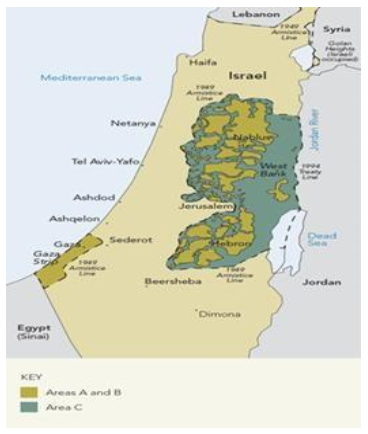
Figure 12
Map of Palestine According to the Oslo Accords in 1994
Source: United Nations Office for the Coordination of Humanitarian Affairs (OCHA), 2019.
Rain-fed agriculture predominates in Palestine, accounting for approximately 81% of the total area of land used for agriculture, with irrigated areas comprising approximately 19% of agricultural land. The irrigated areas are mainly located in the governorates of the Gaza Strip and the Jordan Valley, as well as in the semi-coastal regions of the West Bank. The Israeli occupation imposes obstacles and restrictions on the movement of goods and people, land confiscation, wall construction, water and resource confiscation, and settler violations. These restrictions have a detrimental impact on agricultural investments and economic activities in Palestine. Palestinians have no control over more than 63% of their land (Area C) and no more than 80% of their water resources in the West Bank. In the Gaza Strip, the Israeli occupation has led to a reduction of agricultural land and contributed to the destruction of large areas of farmland during the last three wars in 2009, 2012, and 2014. This has further weakened the already fragile agricultural infrastructure and caused farmers to suffer for prolonged periods of time. Additionally, the limited availability of agricultural resources, drinking water, and cultivated areas exacerbates the challenges faced by Palestinians in Gaza. It is important to note that the Gaza Strip is one of the most densely populated areas in the world, with two million people residing in an area of 365 square kilometers.
Regarding the economic aspect of the Palestinian agricultural sector, the value of agricultural production in 2019 at constant prices reached USD 1.0915 billion, which represents an increase of USD 500 million compared to 2015. The added value of the agricultural sector in Palestine was USD 339.1 million in 2012, accounting for 4.6% of the gross domestic product at that time. However, this contribution decreased to 3.8% in 2014, with the added value of the agricultural sector amounting to USD 286.4 million despite its contribution of 8.2% to the GDP in 2000. In the early 1970s, the value of agricultural imports and exports was equal, ranging between USD 20 and USD 30 million. However, by 2014, annual agricultural imports had significantly exceeded exports, with total agricultural imports amounting to approximately USD 212 million, while agricultural exports amounted to USD 67 million, which represents nearly 7% of total exports.
The percentage of the agricultural sector's contribution to the gross domestic product decreased to approximately 13% in 2020, compared to 17.3% in 2019. Agriculture still provides employment for more than 10% of the labor force in the Palestinian territories, which serves as a primary and secondary source of income for many Palestinians, as agriculture heavily relies on family labor. It is a safety net for employment and an indispensable source of food in difficult times. In recent times, Palestinian agricultural activity has contributed 7% to the GDP. The value of Palestinian agricultural commodity exports constituted 11.25% of the total value of exports in 2018.
Water Sector in Palestine
The water sector has been important for the emergence and advancement of civilizations since ancient times. This is because water attracts individuals and groups, paving the way for the establishment of society and the development of its foundations through the establishment of population centers near natural water resources. Human needs for water extend beyond personal use, encompassing areas such as transportation, agriculture, industry, animal husbandry, and others. As a historically agricultural country, Palestine has also paid significant attention to the water sector.
Water Resources In Palestine
There are two important sources of water in Palestine:
Groundwater
Groundwater (GW) is the primary source of water in Palestine, obtained from wells or springs. The total available quantity of groundwater is estimated to be 100 million m3/year in the West Bank and 189 million m3/year in the Gaza Strip, with a part of the Coastal Aquifer present in the Gaza Strip. GW accounts for 95% of the water supply in Palestine, while precipitation is the primary source of groundwater and surface water resources in the occupied Palestinian territories. The precipitation in the occupied Palestinian territories shows significant spatial and temporal variability, with the average annual precipitation being 450 mm/yr in the West Bank and 327 mm/yr in the Gaza Strip. Groundwater is formed in three major drainage aquifers: the Western, the Northeastern, and the Eastern Aquifers.
Western Aquifer Basin: The Western Aquifer Basin is the largest aquifer in the West Bank and has a sustained production of between 362 and 400 MCM per year. However, Israel extensively exploits the basin, occupying approximately 340 to 430 MCM per annum and sometimes exceeding 520 MCM per annum, while in 2012, Palestinians consumed only 28 MCM through wells. The Northeast Aquifer Basin has most of its recharge area located in the West Bank and has annual sustainable production of 100-145 MCM. However, Israel uses the aquifer at a rate of 103 MCM per year, while Palestinians used about 23 MCM per year of water from wells and springs in the basin in 2012.
The Eastern Aquifer's entire recharge area is in the West Bank, giving Palestinians the right to control the water without sharing it with Israel. However, Israel still uses approximately 50 million cubic meters of water in the aquifer, in addition to 100 MCM per year from Dead Sea springs under Israeli control, despite Palestinian claims to the contrary.
Gaza Coastal Aquifer is the only source of water on the Gaza Strip. The aquifer is extremely limited in volume, with annual recharge of 55-60 MCM. In 2012, Palestinians in the Gaza Strip consumed about 185 MCM. Excessive pumping has lowered the water table below sea level, causing saline intrusion in many areas. Only about 53 MCM of well and spring water were used in 2012. Estimated sustainable yield for the basin is between 145 and 185 MCM.
According to the Palestinian Central Bureau of Statistics, 79% of the available water is taken from groundwater data, which showed that the percentage of surface and groundwater exploitation from the available water during 2020 was high, with an average of 79%. On the other hand, the amount of water pumped from Palestinian wells in the West Bank in 2020 amounted to 108.8 million cubic meters from the eastern aquifer, the western aquifer, and the northeastern aquifer.
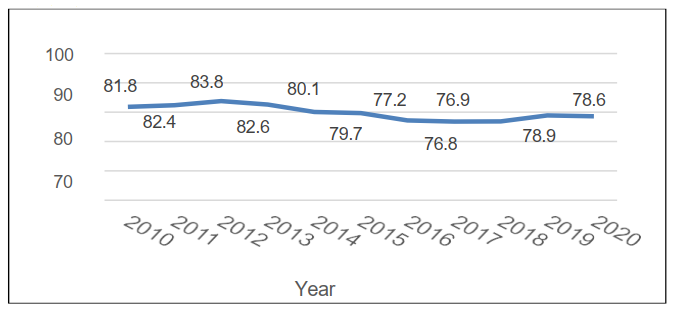
Figure 13
Percentage of Extracted Surface and Groundwater From Available Water, 2010-2020
Source: Palestinian Central Bureau of Statistics 2020.
Surface Water
The surface water resources in historical Palestine are concentrated in the northern and central parts of the region, gradually decreasing as we move towards the south, where they are almost non-existent. These water sources discharge in three main directions: towards the Mediterranean Sea, towards the Jordan Valley and the Dead Sea, and towards Wadi Araba and the Gulf of Aqaba, as well as other directions. The most important sources of surface water in historical Palestine are the Jordan River and its tributaries, Lake Tiberius, Lake Hula, and the main streams of the valleys. The quantity of water flowing into the Lower Jordan River and discharging into the Dead Sea was estimated to be 1400 MCM/y, but this amount has dramatically decreased over the past six decades and is presently no more than 30 MCM/y. However, due to the Oslo Accords of 1994, the Palestinians are not entitled to benefit from the waters of the Jordan River. In the West Bank, a total of 383 Palestinian wells is connected to groundwater systems, but 119 of these are either not pumping, abandoned, or in need of remediation. As of 2is the total volume of water withdrawn from wells was approximately 64 million cubic meters (MCM) per year, of which 36 MCM was for domestic use and 28 MCM was for agricultural use. In Gaza, the total amount extracted in the same year was about 185 MCM, of which about 102 MCM was used for municipal and domestic use, while 83 MCM was used for agriculture.
It should be noted that there are 39 Israeli wells, with an average annual extraction of about 54 million cubic meters. Israel uses more than 500 wells within the Green Line (mainly in the Western Basin). These wells extract more than the annual recharge rate of all aquifers, leaving very limited quantities for Palestinian use.
Non-traditional Water Sources
The Water Authority has implemented methods to bridge the gap between water supply and demand due to the increased demand for water resources and the Israeli occupation policy. These methods include:
Desalinated water: Currently, there is only one desalination plant in the central Gaza Strip with a capacity of 600 m3/day. However, there are plans to expand the plant's capacity to 2,600 m3/day and to build a regional seawater desalination plant with an annual capacity of one million cubic meters by 2017, which will reach 129 million cubic meters per year by 2035. There are also small-capacity private desalination plants in the Gaza Strip.
Treated wastewater reuse: There is limited activity in the Gaza Strip and the West Bank to reuse treated wastewater, with only pilot projects in some areas. The total amount of sewage reused is about 1 million cubic meters per year in the Gaza Strip.
The Reality of Water Sector Under Israeli Occupation Shadow
One of the main consequences of the 1967 occupation was Israel's annexation of much of the headwaters of the Jordan River where a water pump was installed in Lake Kinneret (the source of the Dead Sea), pumping annually 400 million cubic meters of water, in addition to the installation of an Israeli national carrier that transports water (80% for agriculture, 20% for drinking) from northern to southern Israel, resulting in the loss of a large amount of available water supplies for Jordan. The main problem regarding international water resources in the region has been Israel's strict policy of restricting water allocation in the West Bank and Gaza Strip, thus depriving the Palestinians of adequate water. About 40% of the groundwater that the State of Israel relies on and more than a quarter of its annual sustainable water production originate in the West Bank. Israel has developed the water resources it has access to and has established a national water company, Mekorot, which transports water from existing sources of supply to various demand centers for Israeli agricultural, municipal, and industrial customers. After the end of the 1967 war, Israel tightened its grip on water resources, developed wells throughout the West Bank, and established the Mekorot MEMS network, which contributed to the abolition of the Palestinians' water rights in the West Bank. The amount of water provided by Mekorot to the settlements is unofficially estimated at about 75 million cubic meters, of which 44 million cubic meters are produced from controlled wells.
About 11% of the Jordan River Basin is located in the West Bank. In the Unified Jordan Valley Water Plan of 1955, the annual Palestinian quota of 257 MCM was considered part of the 774 MCM of the Jordanian quota. Since 1967, areas along the western side of the river have been expropriated and declared military security zones. Prior to the 1967 occupation, Palestinian farmers owned about 150 pumps in the Jordan River, pumping about 30 million cubic meters annually. The occupying power has destroyed many of these pumps.
As a result of Israel's control over most of the Palestinian water resources in the West Bank and Gaza Strip, the Palestinian water deficit and need have increased. To address this need, the water supply in the Palestinian territories is largely determined by agreements negotiated with Israel for groundwater extraction (internal resources) and water imports. In 2016, the Palestinians purchased about 79 cubic meters of water from the Israeli occupation and, within the framework of the sea transportation project between the Red and Dead Sea, agreed to obtain an additional 32 cubic meters, with an additional 34 cubic meters requested. If these deals are agreed upon and implemented, the Palestinians will buy about 145 cubic meters from Mekorot, the Israeli bulk water supply company. According to the Israeli Water Authority, the share of the Palestinian Authority and the State of Jordan constitutes 6% of the volume of total water consumption in Israel, which amounted to more than 2,340 million cubic meters in 2016.
In the West Bank, the total arrears from the cost of purchasing water from Mekorot in 2017 amounted to about USD 335 million. In 2016, the Israeli Finance Minister deducted USD 94 million from clearing revenues owed to the Palestinian Authority for unpaid Mekorot water and wastewater treatment bills. In 2017, the deductible increased by 10%.
Article 40 of the Oslo II Accords contains provisions on water and sanitation, recognizing the unspecified water rights of the Palestinians and returning some water resources and supply responsibilities in the West Bank to the Palestinian Authority, including the following:
-
Laying down the basics of governance and supervising its implementation.
-
Allocating specific quantities from the three aquifers in the West Bank located under both regions, noting that the share allocated to the Palestinian West Bank is about a quarter of the amount allocated to Israel and the settlements.
-
Estimated future needs for the Palestinian West Bank at 70-80 MCM.
-
Additional supplies in the meantime from new wells and from Mekorot.
Israel continues to implement policies and practices that appropriate and control Palestinian water resources, resulting in an unequal and discriminatory distribution of water resources. These policies benefit Israeli citizens living in Israel and those living in West Bank settlements, while preventing Palestinians from accessing and developing resources, thus undermining their right to self-determination. These efforts are enforced by Israeli military orders that transfer power over water resources and management to the occupation authorities.
Selected Indicators for Water Statistics in Palestine, 2010-2020
|
|
|
||||||||||
|---|---|---|---|---|---|---|---|---|---|---|---|
|
|
|
|
|
|
|
|
|
|
|
|
|
| Annual Available Water Quantity | 331.1 | 323.9 | 349.2 | 365.7 | 342.7 | 365.3 | 363.6 | 375.2 | 389.5 | 417.9 | 448.4 |
| Annual Pumped Quantity from Groundwater Wells | 244.0 | 245.5 | 253.3 | 262.9 | 246.3 | 250.5 | 251.6 | 264.5 | 274.2 | 289.0 | 299.1 |
| Annual Discharge of Springs Water | 26.8 | 21.4 | 39.3 | 39.5 | 28.2 | 40.7 | 29.0 | 23.5 | 25.5 | 40.6 | 53.3 |
| Quantity of Water Supply for Domestic Sector | 178 | 185.5 | 199.9 | 198.4 | 191.3 | 214.9 | 210.2 | 213.2 | 214.0 | 227.3 | 232.6 |
| Daily Consumption Rate per capita (liter/capita/day) | - | - | 77.0 | 79.1 | 79.3 | 82.2 | 83.0 | 88.3 | 87.3 | 81.9 | 84.2 |
| Desalinated Drinking Water) | - | - | - | - | 4.7 | 3.9 | 3.9 | 4.0 | 4.1 | 4.1 | 5.7 |
| Annual Quantity of Water Purchased from Israeli Water Company (Mekorot) | 60.3 | 57.0 | 56.6 | 63.3 | 63.5 | 70.2 | 79.1 | 83.2 | 85.7 | 84.2 | 90.3 |
Source: Palestinian Central Bureau of Statistics 2020.
Upon examining table 5, it can be observed that the daily per capita water consumption increased from 77 to 84 liters per person per day between 2012 and 2020. However, due to water scarcity and Israeli restrictions on access to resources, Palestinians are forced to purchase 20% of their available water from Israel's Mekorot Water Company. In 2020, they bought 90.3 MCM of water, which accounts for 20% of Palestine's water availability (448.4 MCM). Additionally, 53.3 MCM of water was taken from Palestinian water sources, 299.1 MCM was extracted from groundwater wells, and 5.7 MCM of desalinated water was obtained, making up 1% of the water supply. In the Gaza Strip, 201.8 MCM of water is contaminated and not suitable for drinking, while only 246.6 MCM of water is fit for domestic use, including purchased and desalinated water (Palestinian Central Bureau of Statistics, 2022).
Agricultural Insurance in Palestine
The agricultural sector in Palestine faces damages as a result of a wide range of risks, which can be classified into two categories. The first category includes political and institutional risks, while the second category includes market and production risks. The main source of political and institutional risks is the Israeli occupation, with a focus on Area C, which includes restrictions on the movement of goods and people, land confiscation, wall construction, appropriation of water and resources, settler violations, and restrictions on agricultural investments and economic activities. Palestinians have no control over more than 63% of their land (called Area C) and no more than 80% of their water resources in the West Bank. In the Gaza Strip, Palestinians are still suffering from the repercussions of the last three wars against them in 2009, 2012, and 2014, which devastated large swathes of agricultural land, damaged the already weak agricultural infrastructure, and left farmers and all citizens of the Gaza Strip in dire straits. In addition, limited agricultural resources and drinking water, as well as the limited cultivated areas in the Gaza Strip, exacerbate the situation. The Gaza Strip has the potential to have the highest population density in the world, with two million people living in 365 square kilometers.
Market risks mainly consist of exposure to price volatility and inability to access outlet markets due to trade restrictions. Production risks include climatic events, drought, floods, low and high temperatures, as well as pests and diseases that affect the production activities of livestock and agricultural crops. From the foregoing, we note that the political risks that involve the practices of the occupation cannot be covered by any insurance company because they are risks that cannot be predicted. In addition, they destroy the various factors of agricultural production, the most important of which are land and water. As for market risks, diseases, and temperature changes, they can be mitigated or avoided by improving technology.
Despite the obstacles that prevent the establishment of agricultural insurance companies, there are attempts by the Palestinian Authority and international organizations that have resulted in the establishment of the Risk Prevention and Agricultural Insurance Fund (European Commission, 2020). This fund deals with the risks faced by Palestinian farmers, including risks from the Israeli occupation such as land confiscation and water resource scarcity, by compensating them. In addition, the fund performs the following functions in order to develop agricultural insurance in Palestine:
-
The fund has set up a range of projects that aim to gather everything related to agricultural risk management, disaster risk reduction, and agricultural insurance.
-
It brings Arab and foreign expertise in the fields of agricultural insurance, dispatches local staff for external training, and builds the fund's capabilities in technological applications in agricultural insurance.
-
The fund develops a system for agricultural insurance that regulates all aspects related to agricultural insurance and considers the characteristics of the Palestinian agricultural sector and what is compatible with it.
-
The fund creates an investment environment that supports the development of successful agricultural insurance through the participation of the government in bearing the burdens of insurance through the role of the fund and the establishment of companies or branches of companies specializing in agricultural insurance.
Chapter Six. Technology Innovation in Palestine Islamic Insurance Companies
Innovation Technology in a Palestine Financial Services Sector
With Palestine joining the United Nations, it sought to achieve sustainable development goals, especially goals related to technological innovation. Therefore, the government, the private sector and civil society seek to adopt a positive role in activating the application of technology outputs in Palestinian industries to improve living conditions and overcome challenges (Ibrahim, 2020). Palestine, being part of the developing countries, seeks to obtain a share in the global community of science, knowledge and creativity. This requires these countries to create economies based on innovation and technology. That is, they need to adopt technological tools that contribute to building a digital economy as part of the global economy (Rangwala et al., 2020).
In light of the current trend of global markets (EIOPA, 2017), the Palestinian market has recently witnessed successive applications of different technologies by leading companies in different industries (Hassan, 2012). Including the financial services sector, where the Monetary Authority has taken some steps that contributed to improving the use of financial technology, including:
-
The Monetary Authority, in cooperation with the Capital Market Authority, launched the national strategy for financial inclusion in Palestine, which considers financial technology one of the most important pillars for achieving financial inclusion through the delivery of financial services to the target groups at an acceptable time and cost.
-
The Monetary Authority has prepared an internal strategy to promote the financial technology and innovation sector in the sectors that fall under its umbrella (banks, insurance, lending institutions). In this context, it has created the Department of Financial Technology and Innovation and the Department of Financial Inclusion to serve the directions of the Monetary Authority. Capacity Rehabilitation of its employees in this field by establishing the Academy of Financial Technology within the Monetary Authority
-
Strengthening cooperation with international bodies in order to view and benefit from international experiences in the field of financial technology (PMA).
As a result of the measures taken by the Monetary Authority to adopt information technology, digital transformation and benefit from artificial intelligence, it has established an innovation screen in which it receives all innovative and creative ideas based on the digital age, which will contribute to advancing technological development in the non-banking financial sectors, the most important of which is the insurance sector, as stated by the Director General Palestinian Capital Market Authority Buraq Al Nabulsi. In 2021, the Palestinian Capital Authority decided to grant Navatex a no-objection letter to implement Maslak as the first innovation in insurance technology. The Maslak application aims to track and control drivers’ driving behavior based on artificial intelligence, and then works on developing an assessment system for drivers’ driving behavior, as the application serves companies Insurance is in an accurate application of the risks associated with the behavior of insured drivers, enabling it to assess and manage the insurance risks associated with the insured, and in return the possibility of providing encouragement systems for the driver who is disciplined in driving. Ghosheh, General Manager of Naviatics for Information Technology, which developed the( Maslak) application, confirmed that the authority and its staff have provided the control tools that keep pace with the speed of innovations offered through the innovation platform, which was launched earlier. (https://www.palestineeconomy.ps/en, 2021).
Technological Innovation in Islamic Insurance Companies in Palestine
Tamkeen and the Takaful Company are the two specialists in issuing Islamic insurance services in Palestine. The Takaful Company was established in 2006 as the first cooperative company with an Islamic overtone, while in 2017, Tamkeen Insurance was launched to form Islamic insurance with the Takaful Company with a capital of USD 8 million (https://www.altakaful-ins.ps/) (https://www.tamkeen-ins.ps/). To keep pace with the technical and technological development brought about by digital transformation in all fields in the world, especially in insurance services, and in response to the recommendations of the Monetary Authority, Islamic insurance companies in Palestine have adopted several measures to adapt information technology in their various administrative functions, which contributes to achieving corporate strategy. As follows:
-
Insurance companies invested in technological infrastructure to develop their operational systems. In 2019, the Takaful Company updated the company’s data center and provided it with the latest and best servers; Replacing and updating network and communication tools, in addition to SYNERGY HPE, and replacing and updating digital protection and security tools both internally and externally, which created the technological infrastructure for use and reception of modern systems, as well as the improvement of the electronic infrastructure that was followed in the application.
-
Companies specialized in Islamic insurance have invested in electronic development to provide the best electronic services to the beneficiaries of the Palestinian society, which are:
-
Electronic Customer Window: This portal allows officials in institutions and companies who are health insurance subscribers or general insurance, to view the insurance policies and endorsements of their institutions and also view account statements. It also allows subscribers to request updates or changes on their valid insurance policies, and receive renewal notifications, or other requests related to valid insurance policies to complete the procedures for the company to approve them.
-
Mobile Application: The application includes many features for «My Health» Insurance subscribers who benefit from medical care services, where subscribers enter their card number to get many features including: Viewing a detailed report for medical treatments that the subscriber had, in addition of viewing the medical providers network to find the nearest medical center to the geographic location of the subscriber, and getting notifications for using the health insurance card.
-
Electronic System for Medical Bodies and Centers: It is a system for service providers who are qualified to provide medical care and health services from medical authorities and centers within the health insurance program using the health insurance card carried by the beneficiaries of the health insurance program.
-
Chapter Seven. Capacity Building in Insurance Sector in Palestine
Introduction
Capacity includes the independence and self-reliance of individuals, their groups, organizations and communities. It is the ability to plan and respond to challenges. It involves a range of assets such as knowledge and skills, problem-solving and decision-making capabilities, resources, networks and contacts (Woodland & Hind, 2002) .
«Capacity» can be defined as abilities, skills, understandings, attitudes, values, relationships, behaviors, motivations, resources and conditions that enable individuals, organizations, network/sectors and broader social systems to carry out functions and achieve their development objectives over time (Ogunsola, 2011). From the UNDP’s perspective, it is the ability of individuals and organizations or units to perform functions effectively, efficiently, or sustainably. Alternatively, it can refer to the people, institutions, and practices that enable a country to achieve its development objectives. Capacity has both human and institutional dimensions with the following components:
-
skilled human resources
-
leadership and vision
-
viable institutions
-
financial and material resources
-
Effective work practices, including systems, procedures and appropriate incentives.
It is not possible to specify a specific definition of capacity building, but we can offer several definitions for different international organizations and writers as follows:
The United Nations Conference on Environment and Development has defined the term capacity building as follows:
Capacity building includes the human, scientific, technological, organizational, institutional and resource capacities of a country. The primary objective of capacity building is to enhance the capacity to assess and address critical questions regarding policy options and modes of implementation among development options, based on an understanding of the potentials and limitations of the environment and the perceived needs of the population of the country concerned (Ahmed, 2022).
Capacity building is a continuous process to develop innovative capacities in socio-economic settings through ongoing development and adaptation of strategies and processes that enable higher advantage in collective and individual levels (Shams, 2016).
He defined (Hilderbr and Grindle) «capacity building refers to improvements in the ability of public sector institutions, either individually or in cooperation with organizations, to perform appropriate tasks» (Kacou et al., 2022).
Capacity building involves processes that strengthen the capacities of individuals, groups and communities. These processes might include leadership, creating links and networks, encouraging initiatives, facilitating, training and finding resources (Woodland & Hind, 2002).
UNDP recognizes that capacity building is a continuous and long-term process and includes the following:
-
Human resource development, the process of equipping individuals with understanding, skills and access to information, knowledge and training that enables them to perform effectively.
-
Organizational development, the elaboration of management structures, processes and procedures, not only within organizations but also the management of relationships between the different organizations and sectors (public, private and community).
-
Institutional and legal framework development, making legal and regulatory changes to enable organizations, institutions and agencies at all levels and in all sectors to enhance their capacities. Kacou et al. (2022), suggested that abilities operate on three levels:
-
At the individual level, ability refers to technical and analytical abilities, skills, competencies, and/or knowledge.
-
Organizational level, capacity refers to organizational capabilities or the ability to get groups of agents, a team or a unit to properly implement the right policy.
-
At the institutional level, capacity is the general ability of individuals, organizations, societies, states, and societies as a whole to successfully deal with their collective challenges and create long-term benefits for themselves.
-
The World Health Organization (2001) indicates that capacity building depends on four dimensions:
-
Human and organizational skills are required to achieve good employee performance. If the organization in which people work has significant weaknesses, such as for example, a lack of clear vision, inadequate structures, weak internal systems, practices and management, a lack of incentives or a culture that does not encourage good performance, employees will not be able to do so regardless of their knowledge and experience.
-
Planning and implementation abilities. Close links between policies, programs and their implementation are crucial. Both skills need to be considered, but neither should be overrated.
-
Diagnostic skills relevant to the relevant level are required. The capabilities required at the micro level (e.g. planning) are different from those at the top level, where policy and planning capabilities need to receive more attention.
-
Capacity building needs to be expanded. Trial and error, learning by doing, designing new systems and practices, internalizing ways of working, etc. are ways to apply and adapt knowledge and are part of capacity building. This takes a long time, which illustrates the importance of a long-term perspective in capacity building (Milèn, 2001).
However, capacity building inevitably involves a process of transition (or change). It involves more than just improving technical skills, developing new systems, or establishing standards for quality assurance and improvement. These are important, but empowerment is mainly about behavior change (Carter & Moreton, 2016).
Capable Organization
A capable organization is one that effectively combines its human skills, structures, systems, cultures, and processes to achieve the desired service outcomes. Therefore, a capable organization is one which consistently meets its objectives and goals. It achieves this by focusing on the internal processes and systems for meeting its consumer’s needs. It ensures that its workers have the necessary competencies and skills for quality service delivery (Carter & Moreton, 2016).
In a 2002 review of capacity building efforts within the United States, findings showed that the majority of the work commonly referred to as «capacity building» was focused on the organizational level. Organizational capacity building seeks to enhance the ability of an organization or agency to achieve a desired outcome. An enhanced understanding of the components of organizational effectiveness can support capacity building efforts to be effective and purposeful.
Elements of Effectiveness Organization
These elements play an important role in capacity building and development because they include all resources and strategies
-
Components such as aspirations, strategy, organizational skills, human resources, systems and infrastructure, organizational structure and culture.
-
Aspects of organizational life (such as external relations, internal structures, leadership, and management.
-
Pillars of organizational capability, such as relevance, responsiveness, effectiveness and flexibility.
Many frameworks consist of similar organizational elements, with the main differences being how they are grouped into components. This framework for understanding organizational capabilities consists of four main areas: leadership capacity, managerial capacity, technical capacity, and adaptive capacity, which will be explained as follows:
-
Leadership Capacity: Leadership capability is the ability of all organizational leaders to create and maintain vision, inspire, model, set priorities, make decisions, provide direction, and innovate, in order to achieve the vision and mission of the organization (Muzquiz, 2016). Defined it as your ability to change the way you lead to developing more effective ways to obtain results. You must have a strong understanding of both the work you do and the surrounding environment and adapt to the variables imposed by the organization’s internal and external environment. It includes governance, sustainability, and internal leadership.
-
Management Capacity: The concept of management capabilities refers to a wide range of planning procedures used to ensure that a business infrastructure has sufficient resources to maximize its potential activities and production output under any circumstances (Heavy, 2022). It is also the organization's ability to ensure the effective and efficient use of organizational resources (Claussen, 2011) and includes:
-
Human resources: includes all aspects related to employee management, such as evaluating employee performance, managing performance expectations, staffing program, employee development, payroll, benefits administration and related policies and procedures.
-
Financial management: represents an organization's ability to manage and deploy organizational revenues and assets to ensure efficient operations.
-
-
Technical Capacity: It refers to the organization's ability to possess technical capabilities, program design and evaluation, technological skills, marketing skills, and everything digital related to the organization (Kenduiywo & Kirui, 2019). It focuses on the following elements:
-
Ability to design and Implement Programs: this refers to the technical skills to develop an appropriate software design and a logic model of the related software or other evaluation tool that can measure the effectiveness of programming.
-
Marketing skills: the ability to communicate effectively with internal and external stakeholders by possessing effective marketing skills and full knowledge of efficient procrastination strategies.
-
Technology: the organization has the appropriate digitalization in line with its strategy and vision.
-
-
Adaptive Capacity: This refers to the organization's ability to monitor, evaluate, respond and create internal and external changes. The concept of a «learning organization» is illustrated in this area of organizational capability.
-
Environmental learning: the ability to learn about what is happening in the local community as well as keep up to date with what is happening in the field through networking with community leaders and funders.
-
Program Learning: ability to assess client needs and use program evaluation results as a learning tool in enhancing program implementation.
-
Organizational learning: the ability to conduct self-evaluations and utilize the results to implement and follow up on strategic plans (Claussen, 2011).
-
Capacity Building Stages
There are four stages of capacity building: exploration, emergent implementation, full implementation, and sustainability, which can be explained as follows:
-
Exploration stage: In this stage, the required needs are determined, which are determined based on the main objectives of the organization and determine the knowledge, skills, structures and processes that must be provided to achieve the required capabilities. An important task during this phase is to evaluate the current capacity of the organization, perhaps including staff skills, number of employees, computer and other systems, infrastructure, and other resources. The «capacity gap» is the difference between current capabilities and required capacity.
-
Emergent implementation stage: it is explained through the following steps (1) participation of employees of the target organization in the activities; (2) employees build new knowledge, update technological or physical infrastructure, leverage resources, or learn how to use available resources more efficiently; and (3) employees apply their new knowledge and use the new systems.
-
Full implementation phase: This phase involves integrating new information, new skills, and refining practices based on an evaluation of the changes. Evaluations of capacity-building activities can also help inform key actors about the impact and consequences of innovation.
-
Sustainability: This final stage involves «pervasive and consistent» use of the refined skills and practices. Also, the organization demonstrates the capacity and ability to analyze and modify practices for continuous improvement and for any needed refinement of the innovation (Center to Improve Project Performance, 2015).
Capacity Building Strategies
-
Financial assistance and supply of physical resources: In this strategy, a simple lack of resources, both financial and physical assets, is seen as a major lack of institutional capacity. The rationale for this strategy is that the enterprise in question lacks sufficient financial supplies or resources to achieve its efficiency.
-
Improving the organizational and technical capabilities of institutions: This strategy aims to improve the personal, technical and organizational capabilities of organizations so that they perform better what is already being tried. Hence, it is an alternative or a subset of the above strategy with the difference that it is driven by a lack of technical capabilities and appropriate institutional structure rather than resources.
-
Setting strategic goals for an institution: institutions need a clear strategy that leads them to achieve their goals and reach their vision within the resources they possess.
-
Strengthening and activating the network of relationships and the regulatory framework: This strategy aims to help a group of organizations work together to perform complex tasks; the system lacks the organization or its sub-units to perform these functions. Or the interrelationship between sector/system actors needs to be reconfigured to perform their functions. For this strategy to work well, the focus must be on the interrelationships between organizations, individuals and groups of individuals. Again, the two axes described above are important (Langaas et al., 2007).
Capacity in Insurance Corporation
Insurance sector in the country is thriving because of its competitiveness; as a result, firms tend to build robust capabilities to ensure they achieve superior performance which creates greater performance than its competitors in the industry. Low penetration and uptake of insurance is one major setback the insurance industry development is encountering in particular market share (Kipkoech & Kimencu, 2018).
Organizational Capabilities
In today's world, great development is occurring in various fields, especially the economic and commercial fields. These developments reflect the many challenges business organizations face as they become increasingly complex and diverse. All this resulted in these organizations looking for something that would allow them to survive, succeed and continue to grow, hence the concept of organizational capabilities came into being, which suggests that it is a cohesive group that contributes resources to the organization and completes assigned tasks and roles environmental challenges Organizational capabilities are the set of differentiated processes, technologies, and assets that an organization possesses to maintain a sustainable competitive advantage. Organizational capabilities enable companies to deal with and solve business problems, demonstrating elements of continuity in maintaining their operations. Therefore, organizational capabilities are slow to change but can be developed through continuous improvement over a period of time to provide a superior competitive position to the organization. Ahmed (2020) defines capacity building as the organization’s ability to improve the performance of its tasks and activities by using its tangible and intangible resources to achieve success in implementing specific goals.
Therefore, most companies strive to provide adequate service support to frontline employees so that they can serve customers efficiently and effectively. The organization also provides strategic support to enhance the knowledge and skills of its employees, which are key resources to achieve and maintain competitiveness advantage. This organizational support is a strategic resource that enhances organizational capabilities, including differentiation, value, non-imitability, non-refund ability, and non-sustainability (Lee, 2019).
Organizational capability is a key source for generating and developing sustainable competitive advantage. This view suggests that companies that are able to develop and deploy unique, valuable capabilities will gain sustainable competitive advantage. But what exactly is «capability»? However, it has a wide variety of names in literature: core competency, team skills, complex procedures, best practices, or organizational capabilities. There has been considerable debate in the literature about capability and its importance in gaining competitive advantage since the issues of volatile markets; Uncertainty and environmental change have come to the fore. The focus has therefore shifted to the ability to change and thus develop new organizational capabilities as a critical prerequisite for developing sustainable competitive advantages (Ouakouak & Mbengue, 2018).
Organizational capabilities mean that a company is able to use its resources (such as tangible and intangible resources) to carry out activities that improve performance. Organizational capabilities consist of three elements: strategic management capabilities, the ability to build relationships with external stakeholders, and operational capabilities. Thus, closely watched organizational capabilities improve the relationship between organizational resources and organizational performance (Rehman et al., 2019).
Technological Capabilities
He defines IT capabilities as «the ability of an organization to mobilize, deploy, or engage IT-based resources in combination with other resources and capabilities». IT-based resources can be divided into physical resources (such as physical IT infrastructure), human resources (such as management and IT technical skills) and IT-driven intangible resources (such as knowledge resources, customer orientation, synergies, etc.). IT capabilities are critical to achieving competitive advantage and superior business value.
Panda (2017) conceptualized IT capabilities as IT infrastructure capability (i.e. the ability to effectively manage data, architectures, and communications networks), IT business scale capability (i.e. exploit IT resources to advance business objectives), and proactive information technology. Attitude (i.e. the organization's proactiveness to exploit existing IT resources or adopt innovative technology to create business opportunities). IT capabilities enable and facilitate organizational flexibility and adaptability in a highly competitive market environment. In addition to making organizations more flexible in the face of unprecedented environmental changes (Panda, 2017).
Anandhi S. Bharadwaj et al. (1999) study divided the capabilities of information Technology (ITC) in companies into six sections:
-
IT business partnerships: This dimension refers to the company's ability to cultivate comprehensive partnerships between technology providers (IT experts) and technology users (business unit managers). It includes aspects related to bringing together business and IT expertise through multidisciplinary teams and promoting risk sharing and experimentation in IT. Relationship building thus facilitates a broader dialogue between the business and IT communities and involves developing user understanding of IT's potential.
-
External IT linkages: This dimension refers to technology-based connections between a company and its key business partners, including customers, suppliers, and other external collaborators. Inter organizational information technologies, such as electronic data interchange (EDI) networks and other electronic distribution channels, enable complex interactions with suppliers and customers and improve the exchange of knowledge and customer information.
-
Business IT strategic thinking: This concept demonstrates management's ability to envision how IT can contribute to business value and to integrate IT planning into the company's business strategy. The information systems literature strongly emphasizes the importance of integrating information technology and business strategy, arguing that information technology affects a firm's strategy, and strategy affects information technology. Companies that pioneer breakthrough IT innovations have developed a clear understanding of the role of IT and the connection between IT and their core value propositions.
-
IT business process integration: This means being able to adapt existing business processes and IT procedures to continuously improve their effectiveness and efficiency while taking advantage of the possibilities of new information technologies. It requires restructuring existing business practices as well as existing IT workflows to ensure that new opportunities to improve process efficiency are exploited.
-
IT management: IT management explains the activities related to managing IT functions, such as: B. Planning and design of information systems, delivery of information systems applications, management of IT projects, and planning of IT standards and controls. Therefore, the quality of IT management practices has a significant impact on a company's overall IT success. Effective IT management ensures consistency of IT policies across the organization and reduces duplication and redundancy in systems.
-
IT infrastructure: IT infrastructure in companies refers to both data, networking and processing architectures. IT infrastructure influences the wide range of business opportunities available to companies in applying IT to shape global business strategies.
Human Resources Capabilities (HRC)
Human Resources originally originated as «HR departments» in previous generations, focused on exercising control and «monitoring» how a company treats its employees. In the early days, the main focus of HR was on establishing the policies, procedures, rules and boundaries that govern the organization's «human resources», with the techniques used focusing primarily on the transactional elements of HR and payroll. Information on labor is limited and is maintained manually where available. The next evolution of HR is likely to include a shift towards «business-driven HR», where HR supports the business in a more strategic way, enabled by strong links between business needs and HR and people strategy. To meet the growing complexity, economic pressures, global sophistication and other demands of today’s business, HR must become more agile, business and data-driven, and focused on managing the organization’s talent and employee engagement (Deloitte, 2016).
Thoughtful and comprehensive HR management within an organization may indicate an interest in supporting and caring for well-being when HR practices are seen as effective measures that require an employer's investment in employees, commitment and trust in them, or conversely, a lack of interest. As an employee. Human resource management also participates in the strategy formulation process by providing information about the company's internal strengths and weaknesses, which may have a critical impact on the feasibility of the company's strategic choices. In some cases, the organization's unique human resource capabilities become the driving force behind strategy development. For example, IT giant Infosys has developed unique human resource capabilities that give the company a competitive advantage and enable it to provide fast, high-quality services to foreign and Indian customers (Krishnan, 2019).
The Reality of Capacity Building in the Palestinian Insurance Sector
To study the capabilities in Palestinian insurance companies, we must talk about human resource management in the Palestinian insurance sector, because human resources management is responsible for managing the organization’s workforce, or human resources; It is responsible for attracting, selecting, training, evaluating and rewarding employees. Human resources management is considered one of the most important administrative functions that focus on the human element, which is considered the most expensive resource and has the most impact on productivity in the organization (Saleh, 2016). From this standpoint, HRM, in the Palestinian Capital Market Authority authorized to regulate the insurance sector in Palestine, has done the following.
Within the continued efforts of the PCMA in raising the capabilities of its employees, the PCMA’s employees participated in several specialized training courses in the areas of the Capital Market Authority; whereby, the employees of the General Insurance Department participated in two specialized courses that were held remotely, in cooperation with the Financial Services Institute of the Egyptian Financial Supervisory Authority, relating to agricultural and micro-insurance, in addition to participating in a training program organized by the Arab Monetary Fund, relating to the control and supervision of the insurance sector, in addition to a training program relative to the reinsurance and its applications (Palestinian Capital Market Authority (PCMA), 2022).
Insurance companies also provided training courses for insurance sector employees in the following specializations:
-
Natural hazards and life insurance
-
Governance applications in insurance companies
-
International accounting standards
-
Civil liability and fire insurance
-
Strategic Planning (Palestinian Federation of Insurance Companies, Training courses)
-
Traffic accidents
The Capital Market Authority has worked to develop a professional certification program specializing in insurance. The program provides a set of certificates and qualifications that are obtained through self-study, as some of the certificates that make up this program are considered a prerequisite for obtaining a license to practice insurance professions or some technical and administrative jobs in the country. Insurance companies. The program also provides the opportunity for those interested in developing their capabilities in the insurance industry, whether taken as an individual certificate or as a professional qualification. It meets the urgent needs of raising technical competencies in the Palestinian insurance sector. This program was developed in cooperation with prestigious regional institutions, specifically the British Chartered Insurance Institute. Institute (CII), which is the highest professional body in the world in the field of building insurance capabilities by granting certificates and diplomas for the insurance industry, leading to the CII Fellowship, which is recognized on a global level. The Life Office Management Association (LOMA), which specializes in granting various professional qualifications in the life insurance industry, in addition to the Bahrain Institute of Banking and Financial Studies (BIBF), which is one of the leading regional institutions in the field of building technical capabilities for the insurance sector in the Arab world.
As for technological capabilities, in 2018, the Palestinian government adopted the Palestinian National Strategy for Financial Inclusion 2018-2025. The goal is to increase the number of citizens using financial services to 50% by 2025 from the current 36.4%. This includes women, young people and the unemployed.
It is worth recognizing the critical role played by the Palestinian Monetary Authority (PMA) and the Palestinian Capital Markets Authority (PCMA) in promoting financial services coverage and inclusion of underserved and economically excluded populations. In 2020, the PMA approved the use of mobile payment services and digital wallets and established the first fintech academy in Palestine. In 2021, the PMA established the National Fintech Working Group to develop the fintech industry, promote digital transformation and improve the infrastructure of the Palestinian payment system, while making governance and procedures transparent and avoiding monopolies in the field. In addition, a regulatory sandbox was recently established to test innovative solutions in a safe and supportive environment (Shawwa, 2020).
The Palestinian Capital Market Authority has created an appropriate environment to enhance the use of financial technology in the non-banking financial sector. In 2021, the Authority added the Department of Digital FinTech Services and Innovation to its organizational structure and launched the Ibtikar platform, which aims to encourage innovators to create pioneering ideas related to the non-banking financial sector.
In 2022, the Capital Markets Authority created a favorable environment for the introduction of an experimental regulatory environment, which is considered an experimental environment that allows innovative non-bank financial technology service developers to test innovative financial technology applications on-site and realistically. World customers and provide an experimental regulatory environment for emerging companies in the fintech sector. The ability of modern companies to operate in experimental environments and provide services to a limited number of consumers helps their business models mature. The experimental regulatory environment aims to reduce the cost of innovation and create space for regulatory agencies to enter. It provides a secure, formal framework for direct testing and market surveillance, which is considered an indicator of regulators' openness to innovation, by testing innovations in live markets at specified times and scales based on their implementation. An appropriate regulatory environment is required before innovation can have a full impact on the market. It was necessary to refer to the «Innovate» platform to clarify the innovative capabilities in Palestine through financial technology adopted by the Palestinian Capital Market Authority (the trial version as we mentioned previously).
(Innovate) Platform
It is a platform created by the Palestinian Capital Market Authority to receive innovations from entrepreneurs that contribute to the technological development of the insurance sector and other non-banking sectors. The number of applications processed through the «Innovation» platform in 2022 reached 40 innovations, with different categories of applications sent. These innovations were directed to suit the Authority’s policy and the needs of the non-banking financial sector in Palestine, by providing follow-up and guidance for them. It should be noted that the insurance sector accounted for the largest percentage of the number of innovations submitted to the platform, followed by innovations related to the financial leasing and securities sectors. As in figure 14:
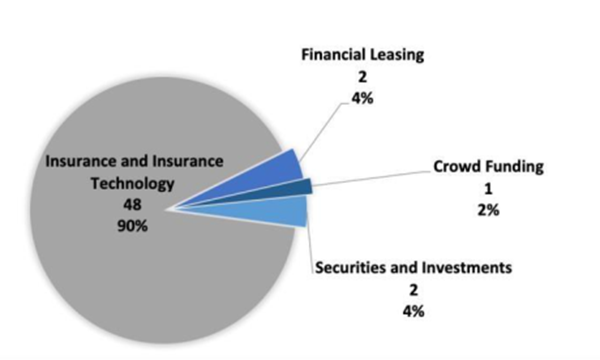
Figure 14
Number of Innovations Received, Classified by Sector
Source: Capital Market Authority
In general, there are low levels of access to and limited use of financial services, and large numbers of adults remain excluded from the formal financial system due to political and/or social and economic constraints. One of the most important factors and challenges that hinder progress in the field of financial technology in the insurance sector and other sectors are the obstacles resulting from the occupation and the restrictions it imposes on the Palestinian economy, such as depriving Palestinians of fourth and fifth generation services (in Gaza, third generation). Decision makers in Palestine must develop and enact laws and legislation related to financial technology, create the appropriate infrastructure for electronic payment systems, and ensure the security of information and the protection of privacy and individual data. And to provide the appropriate ground for constructive interaction between regulatory bodies, businessmen, and innovators of financial products and services.
Conclusion
The Palestinian insurance sector is a special case as it belongs to the Palestinian economy, which is affected by the repercussions of historical events on the reality of the insurance sector in Palestine. This is what the study confirmed by tracing the historical path of the insurance sector in Palestine and showed that the insurance sector in Palestine is stable and enjoys vitality in cases of political stability, and in return. The insurance sector is affected by the turbulent political situation, which negatively affects the performance of the insurance sector.
The Oslo Peace Agreement in 1994 marked a radical turning point in the historical path of the Palestinian insurance sector. It contributed to the establishment of the Palestinian National Authority, which is concerned with the political, social and economic management of the Palestinian territories. The Palestinian Authority formed a supervisory role over insurance activities in Palestine through the Palestine Monetary Authority, but the insurance sector continued to suffer from the absence of regulation and oversight until the issuance of Palestinian Insurance Law No. 20 of 2005 and the secondary legislation issued pursuant to it, so that the Palestinian Capital Market Authority would regulate the insurance sector. In Palestine and supervising it in accordance with the Insurance Law, the Authority has given the insurance sector special importance to ensure the achievement of the economic and social goals desired by insurance activity, and to ensure that insurance companies continue to fulfill their insurance obligations, and to protect the rights of insurance policyholders and beneficiaries, through continuous follow-up and ensuring the strength of the companies’ financial positions. Insurance, financial solvency and hedging against the risks to which they may be exposed. In accordance with global best practices and international principles established by the International Association of Insurance Supervisors (IAIS) and adopting a risk-based supervision and control approach. Which contributed to improving insurance activities through its organization and monitoring? Therefore, the Insurance Law constituted the legal reference for all insurance activities in Palestine. Therefore, the study concluded as follows.
The study concluded, by tracing the historical path of the Palestinian insurance sector, that before 1994 there was no independent Palestinian insurance sector, but rather there were Arab and foreign insurance companies operating in Palestine through their branches in Palestine, with the exception of the Arab Insurance Company, which was established in 1944 and after the war, in 1948 the company's business was transferred to Lebanon. Even after the 1967 war, branches of Israeli insurance companies were introduced to the West Bank and Gaza Strip. The insurance sector was formed by the establishment of the Palestinian Authority under the Oslo Accords in 1994 to be a starting point for the establishment of an independent Palestinian insurance sector. Thus, the activity of insurance companies expanded to include new geographical areas that were not part of their activities before 1994. The Palestinian Authority also allowed the entry of Arab and foreign companies into the Palestinian insurance market, and Israeli insurance companies were excluded, In addition, the Palestinian Authority has created the appropriate climate for the Palestinian insurance sector to develop by establishing the Palestinian capital market to supervise and control insurance work, eliminating chaos in insurance activities, and promoting insurance confidence, as it is the body authorized by law, and through the General Insurance Administration, to set detailed policies that aim to Developing and developing the insurance sector, preparing the necessary systems, and providing the appropriate environment for the growth and progress of the insurance industry. The public benefit of general economic activity in Palestine in cooperation and coordination with the concerned authorities. It also works continuously to develop plans that ensure the development and organization of the insurance sector and the dissemination of insurance awareness among members of society, in cooperation with all components of the insurance sector.
Despite the development of the Palestinian insurance sector during the last decade, it is still in the preliminary stage of its effectiveness in contributing to the GDP of the Palestinian economy, as it contributed only 1.9% of the GDP in 2019. The main reason is the lack of insurance awareness in Palestinian society, which is this is confirmed by the insurance density of the Palestinian individual, which in 2019 amounted to USD 60 per person, on the other hand, the insurance products offered in the Palestinian insurance market suffer from conflicting demand for them. For example, the share of vehicle insurance constitutes approximately more than two-thirds of the shares of other insurance products, followed by health insurance, which constitutes approximately 10% in 2019. The Palestinian market faces an intense state of competition among companies due to the small size of the market and the lack of expansion of the insurance base. This is because 12 companies were operating in 2019, operating through 160 branches and offices, and 300 agents, marketing insurance products in a small market that does not exceed the total assets in circulation in it. More than USD 360 million, and what is worth mentioning is that three companies control approximately 52% of the insurance portfolio in Palestine and that seven companies represent the remaining 48%, and that vehicle insurance constitutes approximately 67% of the insurance portfolio, and health insurance approximately 11%, workers 8%, and the rest of the insurance accounted for approximately 8%. Therefore, companies operating in Palestine face the challenge of intense competition (large competition due to the saturation of a small market with a large number of companies), which leads to each company seeking to obtain a larger share of the market in light of the low profitability of companies. Stronger competition means lower prices because it is the easiest way to increase market share. But this leads to low profitability or loss for a large number of insurance companies. It must be noted that 75% of companies’ insurance operations activities occurred due to a mandatory law, which is vehicle insurance (legally binding) and workers’ insurance, and not due to commercial and marketing activities and efforts undertaken by companies. Therefore, this means that there are areas open for these companies to work on expanding the insurance base through (working on optional insurance).
Therefore, it is important for insurance companies to expand their insurance base by expanding the insurance base for poor and marginalized groups and small businesses that are surrounded by risks and vulnerable to failure. This expansion is focused on seeking to expand the optional insurance base and heading towards the poor classes and small businesses with the aim of enabling them to benefit from insurance services. and finance, thus achieving mutual benefit between the two parties (insurance sector, individuals and small businesses), and this is done through a mechanism aimed at reducing poverty and strengthening vulnerable small businesses by providing small and soft loans, and this requires the presence of a micro-insurance system to guarantee these loans and protect individuals’ savings. Of potential risks.
What is worth noting carefully is that life insurance constitutes only 2% of insurance products in the Palestinian insurance sector. The reason is due to the lack of insurance awareness and the Islamic character of Palestinian society, It is important to point out that life insurance is the most valuable due to its long-term investment potential, while car insurance is the least profitable, as its investment potential is limited to short-term instruments such as certificates of deposit. In Palestine, there is great potential in the Palestinian insurance sector to expand the penetration of life, housing, and civil liability insurance, and introduce new insurance products, such as medical malpractice, critical illness, and other professional liability coverage.
Takaful has developed in recent years in the Islamic and Arab world because it fulfills the principles of Islamic law in Islamic insurance and thus insurance clients fulfill their religious beliefs and provides them with the required risk coverage for individuals and international financial institutions. Islamic banking, capital market and insurance services are integrated with each other in an ecosystem compatible with Islamic law. As for Islamic insurance (Takaful), which is active in the Palestinian insurance sector, it has not presented itself as a strong alternative to traditional insurance due to the similarity of the insurance products issued by traditional insurance. Therefore, members of Palestinian society, especially those who believe that traditional insurance is contrary to Islamic law, refrain from purchasing the products. Islamic insurance In addition, Islamic insurance still suffers from not promoting itself locally as better than traditional insurance. The best proof of this is that there are only two companies specialized in Islamic insurance products in the Palestinian insurance sector out of nine companies, which are respectively the Islamic Takaful Insurance Company and Tamkeen Islamic Insurance Company, meaning that Islamic insurance constitutes 20% of the total Palestinian sector. The insurance and Islamic insurance sector contributed 21% of the insurance portfolio at the end of 2019.
This is due to the gap between actual practices in terms of underwriting, investment policies, Sharia controls and standards for Takaful insurance companies, in addition to the lack of human resources specialized in Islamic insurance tools. This has contributed to the lack of confidence among a large segment of individuals and institutions in Takaful insurance companies due to the lack of credibility of some. Companies Insurance fail to pay the full insurance policy dues, or delays in paying them. The inability of insurance companies to produce marketing programs and methods that help convince individuals and companies to turn to Takaful insurance, and the emergence of a contradiction between the quality of services provided by Takaful insurance companies and the credibility of marketing programs.
Also, the marketing propaganda of Takaful insurance companies gives the impression that they are profitable investment companies that are not attractive and convincing for the services they provide in exchange for the high volume of premiums. There are also marketing problems, represented by the weakness of marketing insurance services, and companies do not have effective programs to raise insurance awareness among members of society. Agents always focus only on commission in transactions and not on marketing insurance services, attracting customers, and providing good services.
The Palestinian market suffers from the lack of insurance expertise in general and from specialized expertise in the field of Takaful insurance and the lack of institutionalization of qualification and training for cadres working in this sector, as evidenced by the weakness of the field of marketing and expansion of the insurance base. Therefore, there is an urgent need to institutionalize training and the existence of a more comprehensive method to overcome all forms of weakness that Takaful insurance suffers from.
The agricultural sector is considered one of the most important components of the Palestinian economy through its contribution to the gross domestic product, providing job opportunities, and its contribution to national commodity exports. Not only that, but the agricultural sector is of special importance to the Palestinians, as it remains a symbol of steadfastness, confrontation, and clinging to the Palestinian land targeted for confiscation and settlement by the Israeli occupation, with its ongoing practices and attacks on Palestinian lands and waters. Settlement poses a real political threat to agricultural insurance activity, which is considered one of the most important pillars of agricultural development. In addition to political risks, environmental and natural climate risks have been a constant source of agricultural damage and losses, to the point that they have become a real burden that threatens the success of agricultural sector development programs in Palestine.
In addition to the above-mentioned risks, agricultural insurance in Palestine, like the various insurance classifications, faces several obstacles that have prevented its development so far, the most important of which is the lack of human capabilities (experience, knowledge) specialized in the field of agricultural insurance, which affects the performance of insurance service provision. There is also a weakness in the technological and digital infrastructure that prevents the creation of an appropriate climate to adopt the digital transformation that keeps pace with global digital and technological development.
Therefore, agricultural insurance companies in Palestine cannot bear or anticipate the risks resulting from these risks, especially the risks of the Israeli occupation due to the occupation practices that involve the destruction of two basic components of the agricultural sector: land and water. Israeli restrictions prevent Palestinians from exploiting more than a third of the West Bank. The Israeli occupation also contributed to reducing Palestinian water resources by controlling various springs and classifying them as Land C (according to the 1994 Paris Agreement). In addition, it restricts the freedom of Palestinians to dig underground wells by requiring them to reach only a specific depth available to them.
The main threat to Palestinian water is the restriction of water distribution in the West Bank and Gaza Strip, depriving Palestinians of adequate water. About 40% of the groundwater on which the State of Israel depends and more than a quarter of its annual sustainable water production comes from the West Bank. Israel developed the available water resources and established the Israeli Mekorot Company, which transports water from its extraction sources to various demand centers for Israeli agricultural and industrial customers. After the end of the 1967 war, Israel tightened its grip on water resources, developed wells throughout the West Bank, and established the Mekorot MEMS network, which contributed to the elimination of water rights for Palestinians in the West Bank. The amount of water that Mikuruto informally provides to settlements is estimated at approximately 75 million cubic meters, of which 44 million cubic meters is produced from controlled wells.
The Palestinian water deficit and need increased. To meet this need, water supplies in the Palestinian territories are largely determined by agreements negotiated with Israel for groundwater extraction (internal resources) and water imports. In 2016, the Palestinians bought about 79 cubic meters of water from the Israeli occupation, and within the framework of the maritime transport project between the Red and Dead Seas, they agreed to obtain an additional 32 cubic meters, with a request for an additional 34 cubic meters. According to the Israeli Water Authority, the share of the Palestinian Authority and the State of Jordan constitutes 6% of the total volume of water consumption in Israel, which amounted to more than 2,340 million cubic meters in 2016.
As for the second resource (land), the Israeli occupation controls most of the Palestinian lands, as 62.9% of the West Bank is classified within Area C according to the Oslo Accords. Only 18.8% of the West Bank falls within Area B, which is under joint Israeli-Palestinian administrative and security control, while only 18.3% is classified as Area A, the only area under full Palestinian control.
Palestine seeks to achieve sustainable development goals, especially goals related to technological innovation. Therefore, the government, the private sector, and civil society seek to adopt a positive role in activating the application of technology outcomes in Palestinian industries to improve living conditions, overcome challenges, and strive to obtain a share in the global science and knowledge community. And creativity. This requires creating an economy that depends on innovation and technology, and therefore the insurance sector depends on information technology applications because there is a lot of information that is collected, processed and distributed in addition to managing daily, monthly and annual operations. Insurers can leverage the advantages of ICT to be more efficient and effective and gain competitive advantages. The Monetary Authority, in cooperation with the Capital Market Authority, launched the National Strategy for Financial Inclusion in Palestine, which considered technological innovations used in insurance. It sought to spread these applications among members of society through awareness and educational campaigns implemented by the Palestine Monetary Authority in cooperation with various insurance companies. The Palestine Monetary Authority has also prepared an internal strategy to strengthen the financial technology sector and innovation in the sectors that fall under its umbrella. As a result of the measures taken by the Monetary Authority to adopt information technology, digital transformation, and benefit from artificial intelligence, it created an innovation screen through which it receives all innovative and creative ideas based on the digital age, which will contribute to advancing technological development in the non-banking financial sectors, the most important of which is the insurance sector in 2017. 2021 The Palestinian Capital Authority decided to grant Navatex a letter of no objection to implement Maslak as the first innovation in the field of insurance technology. The Maslak application aims to track and monitor drivers’ behavior while driving, relying on artificial intelligence, and then works to develop an evaluation system for drivers’ behavior while driving, as the application serves insurance companies in accurately implementing the risks associated with drivers’ behavior.
The technological revolution and digital innovations have contributed to imposing a new strategy through which companies interact with customers, and its essence is the interaction between digital transformation and the performance of insurance companies in Palestine with their various operations and strategies. As a result, retailers have made great strides in adopting digital platforms to provide satisfying customer experience. With the increasing popularity of mobile phones and social media, consumers have come to rely on smart phones and tablets to search, compare prices, and purchase products online. However, customers expect the same intuitive, streamlined experience from their insurers as they do from their favorite app, search engine, or online retailer. Insurance companies must modify their business models and strategies to remain competitive, which contributes to increasing the shares of companies that adopt digital transformation in their strategies. Perhaps the most important changes will be in the way insurance products are sold and maintained and the use of customer data. These changes will lead to much higher levels of personalization, thus changing the customer’s experience and value proposition.
As for the reality of technological innovations in Islamic insurance companies in Palestine, several measures have been taken to adapt information technology to its various administrative functions, which contributes to achieving the company’s strategy. Insurance companies have invested in technology infrastructure to develop their operational systems. Takaful Company updated the company's data center and provided it with the latest and best servers and replaced and updated digital protection and security tools internally and externally, in addition to improving the electronic infrastructure, which was followed in the application. Companies specialized in Islamic insurance have also invested in electronic development to provide the best electronic services to beneficiaries of the Palestinian community. These are: the electronic customer window, in addition to the mobile application. The application includes many features for «Sihaty» insurance subscribers who benefit from medical care services.
Despite the measures taken by Islamic insurance companies in terms of activities that contribute to adopting a digital transformation strategy, these investments in adopting technological innovations are in their early stages (the foundational stage), such as investing in technological infrastructure to develop operating systems, modernizing institutional data centers, and improving electronic services. Infrastructure for receiving and using modern electronic systems.
Insurance companies seek to build strong capabilities to ensure superior performance, creating greater performance than their competitors in the industry. The low rate of insurance penetration and absorption is one of the main setbacks faced by the development of the insurance industry, in particular, in market share. Because of this, companies seek to possess organizational capabilities, technological capabilities, as well as human resource capabilities, and other capabilities that contribute to achieving their strategy.
Therefore, the reality of capacity building in the Palestinian insurance sector is through the capabilities of human resources in the insurance sector, as the Palestinian Financial Market Authority worked with the help of international institutes to adopt specialized insurance training programs for workers in the insurance sector. It meets the urgent needs to raise technical competencies in the Palestinian insurance sector and develop the capabilities of employees in companies. Insurance in the insurance industry and following international standards in building human capabilities. As for technological capabilities, in 2018 the Palestinian government adopted the Palestinian National Strategy for Financial Inclusion 2018-2025. The goal is to increase the number of citizens using financial services to 50% by 2025 from 36.4% currently. This includes women, youth, and the unemployed. On the other hand, the Palestinian Capital Market Authority has contributed to creating the appropriate environment to enhance the use of financial technology in the non-banking financial sector. In 2021, the Authority added the Department of Digital Financial Technology and Innovation Services to its organizational structure and launched the Innovation Platform, which aims to encourage innovators to create pioneering ideas related to the non-banking financial sector.
Thaer Hurani

Holds a Bachelor’s degree in Finance and Banking from Al-Quds Open University, a Master’s degree in Institution Building and Human Development from Al-Quds University, and a PhD in Business and Economics with honors from the University of Granada. His interests include economic history, insurance, and agricultural business. He is currently researching digital transformation and innovation and their impact on the agricultural sector in Palestine. He has published an article in the journal Agua y Territorio entitled Towards the development of agricultural insurance in Palestine, considering the challenges of water and land.
Página legal
2026, Books2bits
Calle 11 N.° 341 5º A – (1900) La Plata, Buenos Aires, Argentina
https://www.facebook.com/books2bits
https://www.youtube.com/channel/UC-WmTLsmQELvqEkP2zEU0LQ
editorialbooks2b@gmail.com
2026, Thaer Hurani
DOI: https://doi.org/10.51438/B2Bhurani2026
IMPRESO ISBN 978-631-6720-21-4
PDF ISBN 978-631-6720-22-1
HTML ISBN 978-631-6720-23-8
EPUB ISBN 978-631-6720-24-5
Queda hecho el depósito que establece la Ley 11.723
Corrección de estilo: Books2bits
Diseño de tapa: Leandra Larrosa y Camila Pulido
Maquetación PDF e impreso: Federico Banzato
Maquetación automatizada HTML y EPUB: Víctor Pulido Zamora y Víctor Hugo Segundo Escobar
Gestión de contenidos: Lucía Correa
Dirección de la colección: Juan Manuel Matés Barco
Dirección editorial: Guillermo Banzato
La editorial hace suya la evaluación realizada por el jurado de tesis nombrado por el Programa de Doctorado en Ciencias Económicas y Empresariales de la Universidad de Granada: Julio Tascón Fernández, Carlos Larrinaga González y María Vázquez Fariñas.
La responsabilidad por las opiniones expresadas en las publicaciones de Books2bits es exclusiva de los autores firmantes y no necesariamente refleja los puntos de vista de la editorial.
Tracing the Evolution of Palestinian Insurance © 2026 de Thaer Hurani está bajo una Licencia Creative Commons Atribución-NoComercial-SinDerivar 4.0 Internacional.. https://creativecommons.org/licenses/by-nc-nd/4.0/

Bibliography
Abdeljawad, I., Dwaikat, L. M., & Oweidat, G. (2020). The Determinants of Profitability of Insurance Companies in Palestine. An-Najah University Journal for Research, 36(2). http://dx.doi.org/10.2139/ssrn.3533345
Abdul Rahim, A. W., Lewis, M. K., & Hassan, M. K. (2017). Islamic takaful: Business models, Shariah concerns, and proposed solutions. Thunderbird International Business Review, 49(3), 371-396. https://doi.org/10.1002/tie.20148
Ahmed, J. S. (2020). Organizational capabilities and their role in enhancing of the organizational immune system Analytical study in the Iraqi insurance company. Muthanna Journal of Administrative and Economics Sciences, 12(1), 171-184. https://doi.org/10.52113/6/2022-12-1/171-184
Ahmed, M. M. (2022). Defining the Capacity Building Concept. https://www.researchgate.net/publication/362097708_Defining_the_Capacity_Building_Concept
Ajluni, S. (2003). The Palestinian Economy and the Second Intifada. Journal of Palestine Studies, 32(3), 64–73. https://doi.org/10.1525/jps.2003.32.3.64
Al-Amri, K., & Hossain, M. Z. (2015). A survey of the Islamic insurance literature – takaful. Insurance Markets and Companies. International Journal of Economic Research, 14(9). https://serialsjournals.com/abstract/70166_16.pdf
Alhumoudi, Y. A. (2012). Islamic insurance Takaful and its applications in Saudi Arabia. [Phd Thesis]. Brunel University. http://bura.brunel.ac.uk/handle/2438/7449
Al-Rimawi, M. (2019). Challenges and difficulties of the insurance environment. Palestinian Federation of Insurance Companies Magazine.
Arnon, A. (2007). Israeli Policy towards the Occupied Palestinian Territories: The Economic Dimension, 1967-2007. The Middle East Journal, 61(4), 573-595. https://www.jstor.org/stable/4330449
Assad, N. (2014). An Analysis and Assessment of Customer Satisfaction with Service Quality in Insurance Industry in Palestine. [Master’s Thesis]. Birzeit University. https://www.pif.org.ps/writable/uploads/articles/7ded33a6530249c434a030d7d69598b2.pdf
Barghouthi, A.H.M. (2009). Agricultural Insurance in Palestine: Current Conditions and Recommendations for Future Policy. Palestine Economic Policy Research Institute.
Bharadwaj, A., Sambamurthy, V., & Zmud, R. (1999). IT capabilities: Theoretical perspectives and empirical operationalization. 20th International Conference on Information Systems Proceedings, 35, 378-385. https://aisel.aisnet.org/icis1999/35
Capital Market Authority. (2019). Annual Report. https://www.cma.gov.lb/wp-content/uploads/2020/08/CMA-Annual-Report-2019-En.pdf
Carter, M., & Moreton, J. (2016). Capacity building & change management: A guide for community services. VAADA© Victorian Alcohol and Drug Association.
Center to Improve Project Performance. (2015). Conceptualizing Capacity Building [PDF file]. https://www.ed.gov/media/document/cipp2-conceptualizing-capacity-building-2-10-15pdf-36827.pdf
Claussen, C. (2011). Capacity Building for Organizational Effectiveness. United Way of Calgary and Area.
D'Aprile, J. (2023). Why a Thriving Insurance Industry is Critical to Economic Development? Slayton Search Partners. https://www.slaytonsearch.com/2025/06/what-is-the-role-of-insurance-in-economic-development/
Deloitte Development LLC. (2016). Human capital trends in the insurance industry. https://www.the-digital-insurer.com/wp-content/uploads/2016/08/750-us-cons-human-capital-trends-in-the-insurance-industry.pdf
Dessus, S. (2004). A Palestinian Growth History, 1968-2000. Journal of Economic Integration, 19(3), 447-469. https://doi.org/10.11130/jei.2004.19.3.447
Diabes-Murad, F. (2004). Water Resources in Palestine: a Fact Sheet and Basic Analysis of the Legal Status. The Palestinian Initiative for the Promotion of Global Dialogue and Democracy MIFTAH. https://www.miftah.org/Display.cfm?DocId=6719&CategoryId=4
Economic Monitor. (2019). Palestine Economic Policy Research Institute (MAS), the Palestinian Central Bureau of Statistics, the Palestinian Monetary Authority, the Palestinian Capital Market Authority, 59. https://www.pcma.ps/wp-content/uploads/2022/02/monitor_59_eng.pdf
EIOPA. (2017). InsurTech Roundtable How technology and data are reshaping the insurance landscape. EIOPA. https://register.eiopa.europa.eu/Publications/Reports/08.0_EIOPA-BoS17-165_EIOPA_InsurTech_Roundtable_summary.pdf
Eling, M., & Lehmann, M. (2018). The Impact of Digitalization on the Insurance Value Chain and the Insurability of Risks. The Geneva Papers on Risk and Insurance - Issues and Practice, 43, 359–396. https://doi.org/10.1057/s41288-017-0073-0
European Commission. (2020). Project Title: Building the Palestinian Agricultural Insurance Systems and Services. https://www.bmeia.gv.at/fileadmin/user_upload/Zentrale/Europa/EU-Twinning/April-Juni_20/Building_the_Palestinian_Agricultural_Insurance_Systems_and_Services.pdf
Hassan, M. O. Y. (2012). Evaluating the Benefits of Using Sales Force Automation Technology in the Palestinian Commercial Firms. [Master Thesis] An-Najah National University. https://hdl.handle.net/20.500.11888/7587
Heavy. (2022). https://www.heavy.ai/
Ibrahim, M. (2020). Implementing the 2030 Agenda for Sustainable Development in Palestine: An Innovation-Centric Economic Growth Perspective. Expert Group Meeting on “Socially just transition towards sustainable development: The role of digital technologies on social development and well-being of all”. UNDESA / Division for Inclusive Social Development, in collaboration with UNCTAD and ITU. https://www.un.org/development/desa/dspd/wp-content/uploads/sites/22/2020/09/Maysoun-Ibrahim_UN-EGM-2020-Innovation-and-SDGs.pdf
ICD-REFINITIV. (2020). Islamic Finance Development Report, 2020.
Injass, R. A., Sarmidi, T., & Injas, M. M. (2017). The Paris Protocol and the Palestinian Economy: New Evidence. South East Asia Journal of Contemporary Business, Economics and Law, 12(3), 18-24. https://seajbel.com/wp-content/uploads/2017/05/ECON-301.pdf
Institute of International Finance (2016). Innovation in Insurance: How Technology Is Changing the Industry. https://www.iif.com/Publications/ID/1246/Innovation-in-Insurance-How-Technology-is-Changing-the-Industry
Jose, J. (2017). Impact of Technology on Consumer Behaviour. IRA-International Journal of Management & Social Sciences, 6(2), 264-267. http://dx.doi.org/10.21013/jmss.v6.n2.p10
Kacou, K. P., Ika, L. A., & Munro, L. T. (2022). Fifty years of capacity building: Taking stock and moving research forward. Public Administration and Development, 42(4), 215-232. https://doi.org/10.1002/pad.1993
Kenduiywo, C. K., & Kirui, C. (2019). Technical capacity on implementation of construction projects in Kajiado County, Kenya. International Journal of Management and Commerce Innovations, 6(2), 255-257. https://www.researchpublish.com//upload/book/TECHNICAL%20CAPACITY%20ON%20IMPLEMENTATION-6521.pdf
Khalidi, R. & Taghdisi-Rad, R. J. (2009). The economic dimensions of prolonged occupation: continuity and change in Israeli policy towards the Palestinian economy. United Nations Conference on Trade and Development - UNCTAD. https://unctad.org/system/files/official-document/gds20092_en.pdf
Khan, A. (2016). Islamic Insurance Evolution, Models and Issues. Policy Perspectives, 13(2), 29-61. https://doi.org/10.13169/polipers.13.2.0029
Kipkoech, K. P., & Kimencu, L. (2018). Organizational Capabilities and Performance of Insurance Companies in Nairobi City County, Kenya. International Academic Journal of Human Resource and Business Administration, 3(1), 126-149. https://www.iajournals.org/articles/iajhrba_v3_i1_126_149.pdf
Knesset Research Israel Center. (2018). Israeli Water Sector - Key Issues. https://m.knesset.gov.il/EN/activity/mmm/mmmeng250218.pdf
Krishnan, R. (2019). Human resource management practices in Indian insurance sector with special reference to LIC. International Journal of Multidisciplinary Education and Research, 4(6), 46-50. https://www.multieducationjournal.com/assets/archives/2019/vol4issue6/4-6-14-517.pdf
Kubursi, A., & Naqib, F. (2008). The Palestinian Economy Under Occupation: Economicide. The Economics of Peace and Security Journal, 3(2). https://doi.org/10.15355/epsj.3.2.16
Langaas, M. D., Odeck, J., & Bjørvig, K. (2007). The Concept of Institutional Capacity Building and Review of Road Sector Projects. XXIIIrd World Road Congress, París. https://proceedings-paris2007.piarc.org/ressources/files/6/SP02-Langaas-E.pdf
Lee, D. (2019). Impact of organizational culture and capabilities on employee commitment to ethical behavior in the healthcare sector. Service Business, 14(1), 47–72. https://doi.org/10.1007/s11628-019-00410-8
Levin, J. (2018). The European origins of the Israeli–Palestinian economic union: A genealogical approach. The Economics of Peace and Security Journal, 13(1), https://doi.org/10.15355/epsj.13.1.24
Milèn, A. (2001). What do we know about capacity building? World Health Organization. https://iris.who.int/server/api/core/bitstreams/cfcd72ae-608f-4cf1-a4dd-aa84d0cb180f/content
Muzquiz, D. (2016). Why we created PI Insights: Q&A with Daniel Muzquiz, President of The Predictive Index. Predictive Index. https://www.predictiveindex.com/blog/why-we-created-pi-insights-qa-with-daniel-muzquiz-president-of-the-predictive-index/
Nazarov, I. I., & Dhiraj, N. S. (2019). A Conceptual Understanding and Significance of Takaful (Islamic Insurance): History, Concept, Models and Products. International Journal for Innovation Education and Research, 7(4), 280-298. https://doi.org/10.31686/ijier.vol7.iss4.1408
Ogunsola, L. A. (2011). Libraries as Tools for Capacity Building in Developing Countries. Library Philosophy and Practice. https://scholarworks.sjsu.edu/libphilprac/605/
Ouakouak, M. L. & Mbengue, A. (2018). Organizational Capabilities: A review of middle managers involvement in strategy making process and their ability to take autonomous actions as determinants of company performance. XXIeme Conference de l’AIMS. https://www.strategie-aims.com/conferences/22-xxieme-conference-de-l-aims/communications/2759-organizational-capabilities-a-review-of-middle-managers-involvement-in-strategy-making-process-and-their-ability-to-take-autonomous-action-as-determinants-of-company-performance
Palestine Economic Policy Research Institute (MAS) (2013). Quarterly Economic and Social Monitor, 33. https://mas.ps/cached_uploads/download/migrated_files/20141911102638-1-1640016867.pdf
Palestine Economic Policy Research Institute (MAS). (2016a). Challenges to the Growth and Development of the Palestinian Insurance Services Sector. Background Paper, Roundtable (2). https://mas.ps/cached_uploads/download/migrated_files/20162103110500-1-1640017087.pdf
Palestine Economic Policy Research Institute (MAS). (2016b). Financial inclusion in Palestine. https://mas.ps/cached_uploads/download/migrated_files/20171510103304-1-1640017253.pdf
Palestine Export Strategy – Financial Services. (2014). Tourism Intelligence International. https://paltrade.org/uploads/1595099512406814304.pdf
Palestine Monetary Authority. (2007). Palestine Monetary Authority: Annual Report 2007. https://www.centralbanking.com/central-banking/official-record/1414909/palestine-monetary-authority-annual-report-2007
Palestinian Capital Market Authority (PCMA). (2022). Annual Report. Capacity Building of the PCMA’s employees. https://pcma.ps/en/ereports/annual-report-2022/
Palestinian Central Bureau of Statistics. (2015). Performance of the Palestinian Economy, 2014. Ramallah – Palestine. https://www.pcbs.gov.ps/downloads/book2123.pdf
Palestinian Central Bureau of Statistics. (2018). Performance of the Palestinian Economy, 2017. Ramallah – Palestine. https://www.pcbs.gov.ps/downloads/book2371.pdf
Palestinian Central Bureau of Statistics. (2020). Palestine Statistical Book. https://www.pcbs.gov.ps/downloads/book2545.pdf
Palestinian Central Bureau of Statistics. (2020). Performance of the Palestinian Economy, 2019. Ramallah – Palestine. https://www.pcbs.gov.ps/downloads/book2519.pdf
Palestinian Central Bureau of Statistics. (2023a). Agricultural census. https://www.pcbs.gov.ps/en/publications/?catId=60
Palestinian Central Bureau of Statistics. (2023b). The performance of the Palestinian economy 2020. https://www.pcbs.gov.ps/downloads/book2565.pdf
Palestinian Federation of Insurance Companies, Training courses. (n.d.). https://www.pif.org.ps/sections/view/29/en/training-courses
Palestinian National Authority. (2005). Insurance Law. In Insurance Law No. (20) of 2005. https://www.pcma.ps/wp-content/uploads/2022/02/Insurance_Law1.pdf
Panda, S. (2017). Effects of Organizational Capabilities on Organizational Performance: Empirical Evidences from Indian Banking Industry. [PhD Thesis]. National Institute of Technology Rourkela. https://fileserver-az.core.ac.uk/download/pdf/132352127.pdf
Rangwala, A., Starrs, A., Viale, E., Presutti, D., Bramblet, J., Saldanha, K., & Shibata, N. (2020). Technology Vision for Insurance 2020. We, the Post-Digital People. Accenture. https://www.accenture.com/content/dam/accenture/final/a-com-migration/pdf/pdf-120/accenture-technology-vision-for-insurance-2020-summary.pdf
Rehman, S-u., Mohamed, R., & Ayoup, H. (2019). The mediating role of organizational capabilities between organizational performance and its determinants. Journal of Global Entrepreneurship Research, 9(30). https://doi.org/10.1186/s40497-019-0155-5
Saleh, M., & Saleh, Y. (2016). Adoption of electronic human resources management (E-HRM) technology in Palestine. International Journal of Information, Business and Management, 8(2). https://ijibm.elitehall.com/index4.htm
Salman, S. A., Ab. Rashid, H. M., & Nu Nu Htay, S. (2015). Takaful (Islamic Insurance): When We Started and Where We are Now. International Journal of Economics, Finance and Management Sciences, 3(5-2), 7-15. https://doi.org/10.11648/j.ijefm.s.2015030502.12
Shams, R. (2016). Capacity building for sustained competitive advantage: A conceptual framework. Marketing Intelligence & Planning, 34(5), 671–691. https://doi.org/10.1108/MIP-08-2015-0161
Shawwa, A. (2020). The Path of Fintech in Palestine. This week in Palestine. https://thisweekinpalestine.com/the-path-of-fintech-in-palestine/
Sigma. (2017). Technology and insurance: themes and challenges. https://www.swissre.com/dam/jcr:85c4ccde-50b7-41cf-a2df-d365cc35a6f4/expertise_publication_technology_and_insurance_themes_and_challenges.pdf
Sigma. (2020). World Insurance: Regional review 2019, and outlook. https://corporatesolutions.swissre.com/dam/jcr:30d178c3-45f9-4098-b827-22344a52cba4/sigma4_2020_extra_Complete.pdf
Standing Committee for Economic and Commercial Cooperation of the Organization of Islamic Cooperation (COMCEC). (2019). Proceedings of the 13th Meeting of the COMCEC Financial Cooperation Working Group “Improving the Takaful Sector in Islamic Countries”. https://www.comcec.org/wp-content/uploads/2021/07/PROCEEDINGS-OF-THE-13TH-MEETING-OF-THE-FCWG.pdf
State of Palestine, Ministry of Agriculture. (2016). National Agricultural Sector Strategy (2017-2022). English Strategy 2017- 2022.pdf (unccd.int). Seen the 9th of January 2023.
Swartz, N. P., & Coetzer, P. (2010). Takaful: An Islamic insurance instrument. Journal of Development and Agricultural Economics, 2(10), 333-339. https://www.casact.org/sites/default/files/2021-05/6I_Swartz.pdf
The Israeli Water Authority. (2012). The Water Issue Between Israel and the Palestinians. https://www.gov.il/BlobFolder/reports/water-authority-data-english/he/21-Water-Issues-between-Israel-and-Palestinians-Main-Facts.pdf
United Nations Conference on Trade and Development (UNCTAD). (2015). The Besieged Palestinian Agricultural Sector. https://unctad.org/system/files/official-document/gdsapp2015d1_en.pdf
United Nations Conference on Trade and Development. (1989). Palestinian external trade under Israeli occupation. United Nations Conference On Trade And Development. https://digitallibrary.un.org/record/73951?ln=es
United Nations Conference on Trade and Development. (2012). The Palestinian economy: Macroeconomic and trade policymaking under occupation. https://digitallibrary.un.org/record/739437?v=pdf
United Nations Conference on Trade and Development. (2020). Report on UNCTAD assistance to the Palestinian people: Developments in the economy of the Occupied Palestinian Territory. https://www.un.org/unispal/wp-content/uploads/2020/09/TD.B.67.5.pdf
United Nations General Assembly. (2016). Economic costs of the Israeli occupation for the Palestinian people: the post-October 2023 shocks compounding the historical cumulative cost of the occupation of the West Bank. United Nations. https://digitallibrary.un.org/record/840813?v=pdf
United Nations Office for the Coordination of Humanitarian Affairs (OCHA). (2019). The West Bank including East Jerusalem and the Gaza Strip. https://www.un.org/unispal/document/the-west-bank-including-east-jerusalem-and-the-gaza-strip-january-2019-ocha-map/
United Nations Office for the Coordination of Humanitarian Affairs (OCHA). (2022). Gaza Strip | The humanitarian impact of 15 years of the blockade. https://www.ochaopt.org/content/gaza-strip-humanitarian-impact-15-years-blockade-june-2022
Volosovych, S., Zelenitsa, I., Kondratenko, D., Szymla, W., & Mamchur, R. (2021). Transformation of insurance technologies in the context of a pandemic. Insurance Markets and Companies, 12(1), 1-13. http://dx.doi.org/10.21511/ins.12(1).2021.01
Woodland, J., & Hind, J. W. (2002). Capacity Building Evaluation of Capacity Building Programs. Australasian Evaluation Society International Conference. https://www.aes.asn.au/images/images-old/stories/files/conferences/2002/papers/Woodland.pdf
World Bank. (2003). Twenty-Seven Months - Intifada, Closures and Palestinian Economic Crisis. https://documents1.worldbank.org/curated/en/616581468765333893/pdf/263141270months0Intifada10Closures.pdf
Zurich Insurance Group. (2013). The role of insurance in the Middle East and North Africa. https://www.commercialriskonline.com/wp-content/uploads/uploads/files/databank/The-Role-Of-Insurance-In-The-Middle-East-North-Africa-Zurich.pdf
Websites consulted


